How to Clean Hardwood and Other Floors in a Wet Climate
Floor-by-floor cleaning for hardwood, engineered wood, LVP, laminate, tile, stone, and carpet in a rainy climate: stop grit, limit water, and skip what damages.
The short answer
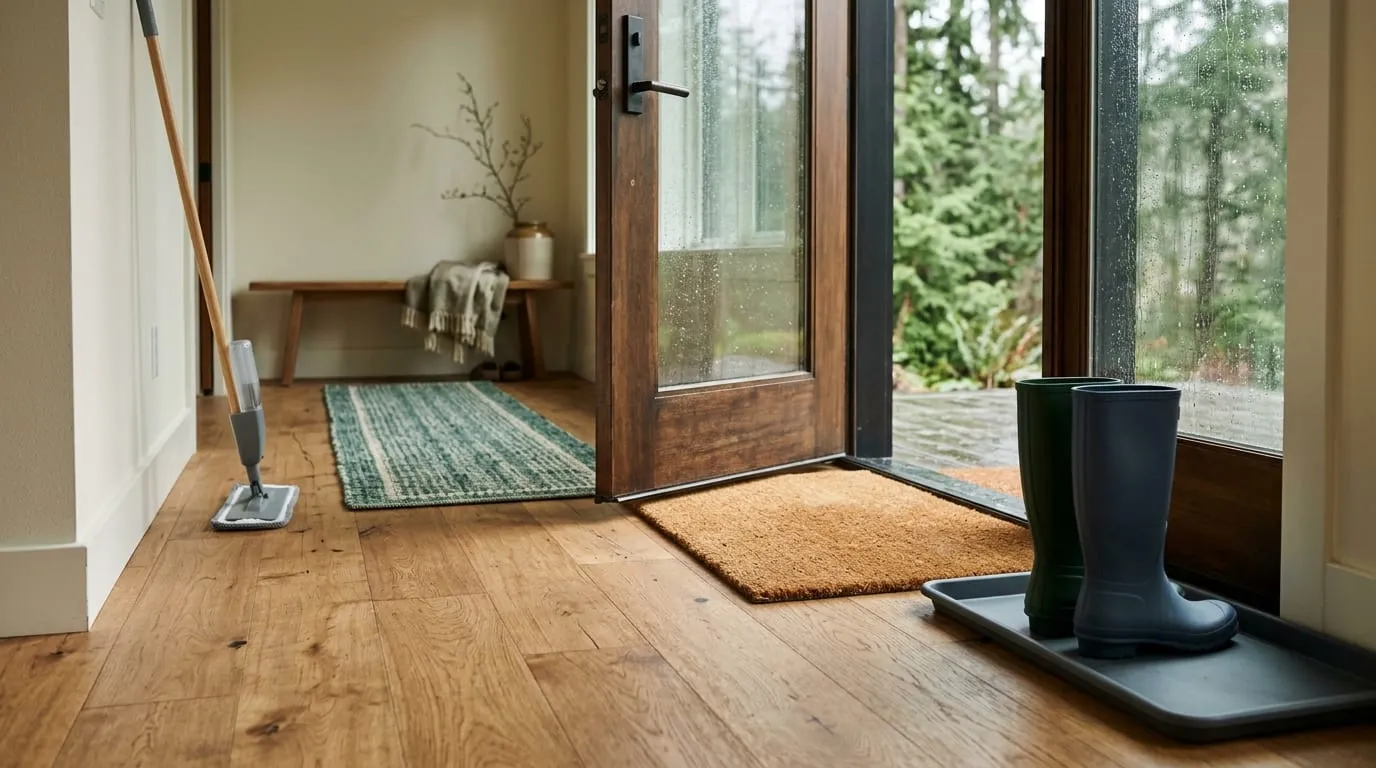
Remove grit first and add as little water as possible: vacuum or dust-mop often, stop wet dirt at the door with mats, and damp-clean with the cleaner your floor's maker specifies. Never steam or wet-mop wood or laminate, keep acids like vinegar off natural stone, and check the manufacturer's care page before trying anything new.
- Grit is the main thing that wears floors. Rainy-season dirt arrives wet and sticks to shoes, so the entry is where floor care starts.
- The National Wood Flooring Association says not to use wet mops or steam mops on wood, and to use a cleaner made for your floor's finish.
- Each floor type has a different no-go list: water on wood and laminate, ammonia and vinegar on luxury vinyl per Shaw, and acids on marble and limestone per Daltile.
- Wood moves with humidity. The NWFA suggests 30 to 50 percent relative humidity year-round to limit cupping and gaps.
- In homes built before 1978, the EPA advises wet mopping hard floors to reduce lead dust and avoiding dry sweeping of paint debris.
This guide is for anyone with hard floors, rugs, or carpet in a place where it rains for half the year. The short answer: get grit off the floor before it gets ground in, stop wet dirt at the door, and use as little water as the job allows. Then match the method to the floor. Wood and laminate hate standing water and steam, luxury vinyl dislikes some common cleaners, natural stone etches with acids, and carpet needs dry soil removed before anything wet touches it.
Below are the reasons, a floor-by-floor table, a routine, and the specific mistakes to avoid.
Why wet climates are hard on floors
Seattle averages about 39 inches of precipitation a year, with measurable rain on roughly 156 days, according to NOAA’s 1991-2020 normals for Sea-Tac. Rain is not the problem on its own. What it does to dirt is.
Grit is the real abrasive
Sand, fine gravel, and the gritty film that washes off sidewalks stick to wet soles and come inside in clumps. Underfoot, those particles act like sandpaper on a finish. The National Wood Flooring Association (NWFA) puts routine sweeping, dust mopping, or vacuuming with the bare-floor setting at the center of wood floor care for exactly this reason, and Shaw’s laminate and tile care pages say the same thing about grit that scratches or dulls a surface. Dull traffic lanes in front of the sofa and kitchen sink are usually grit damage, not a cleaning failure.
Water finds the seams
Most floors are only waterproof on top. Water left standing works into board seams, under the edges of tiles, and into grout. The NWFA explains that wood gains moisture and swells in humid conditions, which can cause cupping (board edges higher than the centers), and loses it in dry conditions, which causes gaps. A soggy entry mat or a wet mop pulled across a floor every week adds moisture where you least want it.
Damp air slows drying
A floor that would dry in ten minutes in summer can stay damp much longer on a cool, gray day with the windows shut. The EPA recommends keeping indoor humidity below 60 percent, ideally between 30 and 50, mainly to prevent mold. The NWFA gives the same 30 to 50 percent range for wood floors, along with an indoor temperature between 60 and 80 degrees Fahrenheit. A cheap hygrometer tells you where you stand.
Floor-by-floor guide
Use this table as a starting point, then confirm with the care page for your specific product. Manufacturers differ, and their instructions are what your warranty is written around.
| Floor type | Routine dry care | Wet cleaning | Avoid | Wet-climate note |
|---|---|---|---|---|
| Site-finished solid hardwood | Dust mop or vacuum on bare-floor setting, several times a week in rainy months | Barely damp microfiber mop with a cleaner made for the finish; NWFA says to use a dry or slightly damp cloth for spills | Wet mops, steam mops, oil soaps or wax over a polyurethane finish | Finish sealed across seams helps, but standing water still gets through worn spots |
| Prefinished (factory-finished) hardwood | Same as above | Follow the manufacturer’s cleaner and method exactly; Shaw specifies its own cleaner applied with a dry mop | Wet mops, steam mops, ammonia, abrasive cleaners, oil-based wax or polish (Shaw) | Seams between boards are not sealed together, so spills should be wiped right away |
| Engineered wood | Dust mop or vacuum | Treat like prefinished hardwood unless the maker says otherwise | Steam and excess water | NWFA notes it expands and contracts less than solid wood, but the top layer is still real wood |
| Luxury vinyl plank or tile (LVP, LVT) | Sweep or vacuum | Damp mop weekly with a recommended cleaner (Shaw) | Abrasive cleaners, ammonia-based and vinegar-based products, harsh chemicals (Shaw); rubber- or latex-backed mats | Water resistant on top, but water under the planks can still reach the subfloor |
| Laminate | Sweep, dust, or vacuum with the hard-floor attachment, not the beater bar (Shaw) | Shaw says not to wash or wet mop with soap, water, or any liquid cleaner; use a product made for laminate | Wet mopping, steam, steel wool, strong ammonia or chlorine cleaners (Shaw) | The core swells if water reaches it, and swelling at the edges does not go back |
| Ceramic and porcelain tile, cement grout | Sweep or vacuum loose dirt before mopping (Daltile) | Damp mop with a cleaner rated for tile and grout; never mop with dirty water (Daltile) | Cleaners not specified as safe for grout; residue left behind | Rinse well: Daltile notes bleach and alkaline cleaners can leave residue that affects slip resistance |
| Natural stone (marble, limestone, travertine, granite, slate) | Sweep or vacuum with beater bar off or raised (Shaw) | pH-neutral cleaner made for stone, then dry the surface (Daltile) | Acids, including vinegar and lemon juice; bleach (Daltile) | Daltile warns acids etch calcite stones like marble and limestone, leaving dull spots that need refinishing |
| Carpet and rugs | Vacuum at least weekly, more in traffic areas and with pets (CRI) | Blot spills; professional deep clean every 12 to 18 months (CRI) | Scrubbing spots with a brush; steam on urine spots (CRI) | Wet mud dries into grit deep in the pile; let it dry, then vacuum it out |
Site-finished versus prefinished hardwood
The NWFA describes two ways wood floors get their finish. A factory finish is applied before the boards arrive, so each board is sealed on its own. A site finish is applied in the room after installation, so the coat runs across the seams. Older houses often have solid strip oak that has been sanded and site-finished, sometimes more than once, while many newer installs and remodels use prefinished planks.
For cleaning, the difference is mostly about where water can go. On a prefinished floor, the small gaps and beveled edges between boards are paths for water. On a site-finished floor, the film bridges those seams until it wears through. Either way, the rule is the same: the NWFA says not to use wet mops or steam mops, which damage the finish and the wood over time, and to use a cleaner made for the specific finish on the floor.
Know your finish before you buy a cleaner
The NWFA lists several finish families. Surface finishes (water-based, oil-based, moisture-cured, conversion varnish, UV-cured, and factory aluminum oxide) form a film on top. Penetrating finishes (natural oils and hard wax oils) soak into the wood, and floor wax forms a low-luster seal that needs more frequent maintenance. A cleaner meant for a film finish is not necessarily right for an oiled or waxed floor, and the reverse is also true. Shaw, for example, tells owners of its hardwood not to use oil-based wax or polish. If you do not know what you have, the installer or flooring professional who finished it can tell you.
The entry: where floor care actually happens
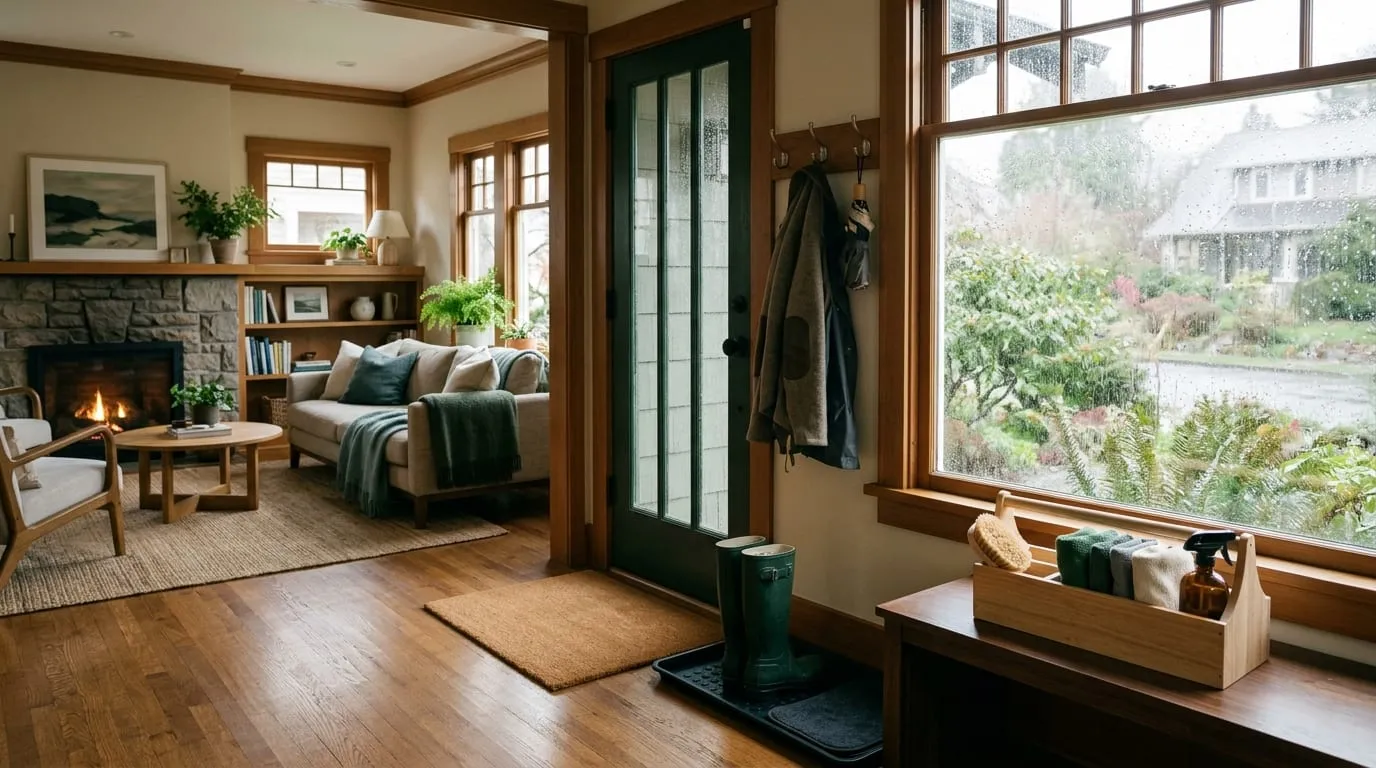
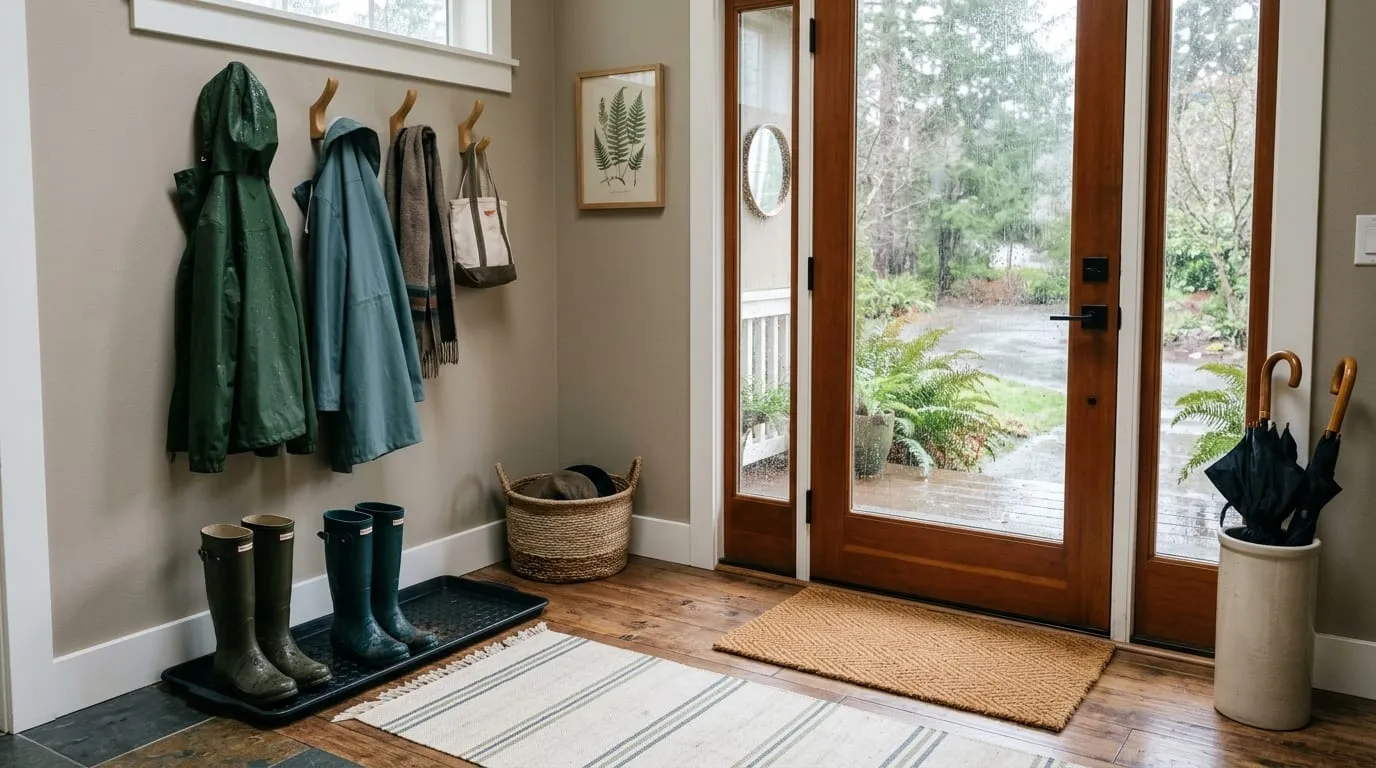
In a rainy climate the door is the single most effective place to protect every floor in the house.
A two-stage mat system
- Outside: a coarse scraper mat (coir or a rubber grid) that knocks off grit and wet leaves. It should be big enough that both feet land on it.
- Inside: an absorbent mat long enough for at least two full strides. Shaw’s hardwood, vinyl, and tile pages all recommend walk-off mats at entrances to trap dirt and moisture.
- A boot tray for wet footwear, so drips land in the tray and not on the floor.
On luxury vinyl, Shaw recommends mats without latex or rubber backing to reduce possible discoloration. The same caution is sensible on many wood finishes; check your floor’s care guide.
Keep the mats working
A saturated mat stops absorbing and starts acting as a wet sponge on the floor beneath it. Vacuum or shake mats several times a week in the wet season, hang them to dry when soaked, and lift them now and then to check the floor underneath for trapped moisture or a musty smell. A shoes-off habit does more for floors than any product.
A routine that works from October to May
The schedule below assumes a household of two to four people with mixed floors. Adjust for pets, kids, and how many people come and go.
- Daily in the wet season: shake or vacuum the indoor entry mat; wipe up any puddle under the boot tray; dust-mop the strip just inside the door.
- Two or three times a week: vacuum or dust-mop all hard floors, starting with kitchen and entry traffic lanes. Use the bare-floor setting or turn the beater bar off on hard surfaces.
- Weekly: vacuum carpet and rugs, including under the edges of entry runners. Damp-mop hard floors with the right cleaner for each type, using a well-wrung microfiber pad.
- Monthly: wash entry mats per their label; check felt pads under chairs and tables (the NWFA recommends protector pads on furniture legs); look at grout lines and stone near the shower or entry for dull spots or staining.
- Seasonally: check humidity with a hygrometer; look for cupping or gaps in wood; schedule a professional carpet cleaning every 12 to 18 months as the Carpet and Rug Institute suggests.
How to damp-mop without overwetting
- Remove grit first. Mopping over sand drags it across the finish.
- Spray cleaner lightly onto the floor or the pad, not in a puddle, and only in the area you are about to mop.
- Use a flat microfiber mop, and wring or swap pads so the pad is damp, not wet. If the floor stays visibly wet for more than a minute or two, you are using too much.
- Work from the far side of the room toward the door, with the grain on wood.
- Change pads when they look gray. Daltile’s point about never mopping with dirty water applies to every floor.
What not to use, and why
Most floor damage from cleaning comes from a handful of habits.
Steam and excess water on wood and laminate
The NWFA says not to use wet mops or steam mops on wood floors, which over time damage both the finish and the wood. Shaw’s hardwood page says the same, and its laminate page goes further, telling owners not to wash or wet mop with soap, water, oil-soap detergent, or any other liquid cleaning product. The common thread is that heat and water get into seams and edges, where swelling cannot be undone by drying.
Acids on natural stone
Daltile explains that calcite-based stones, mainly marble and limestone, react with mild acids such as lemon juice, vinegar, and tomatoes. The result is an etch, not a stain: a dull spot on polished stone that cannot be cleaned away and needs refinishing. Daltile also says stone cleaners should never contain acid or bleach. Many popular “natural” cleaning recipes are vinegar-based, so check before you use one on a stone entry or bathroom floor. The same applies to some tile and grout cleaners, which can be acidic.
Ammonia, vinegar, and harsh chemicals on luxury vinyl
Shaw’s luxury vinyl page lists abrasive cleaners, ammonia-based products, vinegar-based products, and harsh chemicals as things to avoid because they can damage the surface. For a stubborn spot that water and a cleaner will not lift, Shaw suggests isopropyl alcohol on a white cloth.
Product mixing and layering
Never mix floor products, and do not apply two different cleaners to the same area in a row. A residue from one can react with another or leave a film. Our guide to cleaners, sanitizers, and disinfectants covers what each type does and the combinations to avoid.
Carpet: brushes, scrubbing, and steam on urine
The Carpet and Rug Institute (CRI) advises blotting liquids with a dry, white absorbent cloth or plain paper towels until the area is nearly dry, and warns against scrubbing or using a brush, which can damage the fibers. For pet urine, CRI says not to use a steam cleaner, because heat will set the stain and the smell; extract with a wet vacuum and rinse with cool water instead.
Older homes: lead dust and floors
Much of Seattle’s housing stock is old. The EPA says homes built before 1978 are more likely to have lead-based paint, and that dust and chips from that paint are among the most common sources of lead exposure in homes. Floors near old windows, doors, and painted trim collect that dust.
The EPA’s advice for these homes changes the floor routine in specific ways:
- Wet mop floors and hard surfaces to reduce lead dust.
- Do not mop with a scrubber strip attached, power buff, or use polishing machines or vacuums with beater bars, which may wear away painted surfaces.
- If there is visible dust or debris from chipping or flaking paint, use only a vacuum with a HEPA filter, and do not dry sweep.
- Do not shake or beat carpets and rugs.
Notice the tension with the “minimal water” rule for wood. The answer is a damp, well-wrung microfiber pad: wet enough to capture dust rather than push it into the air, dry enough not to soak the wood. If paint is actively chipping, the fix is repairing the paint, not cleaning harder.
A worked example: a Ballard bungalow in November
Consider an illustrative scenario: a 1920s bungalow with original site-finished oak in the living and dining rooms, newer prefinished engineered planks in a kitchen addition, porcelain tile in the bathroom, a marble threshold at the bathroom door, and a wool rug in the living room. Two adults and a dog live there. Here is how the routine fits that mix in a wet week. Times are rough estimates, not measurements.
- Entry, daily (5 minutes). The coir mat outside and a cotton runner inside catch most of the grit. The runner gets shaken every evening and swapped for a dry spare when soaked. Boots go in the tray, and the dog’s paws get a towel at the door.
- Hard floors, three times a week (15 minutes). A vacuum on its bare-floor setting covers oak, engineered planks, and tile in one pass, starting at the back of the house and finishing at the entry.
- Rug, weekly (10 minutes). The wool rug is vacuumed in both directions, with extra passes where the dog lies. Muddy paw prints are left to dry, then vacuumed, never scrubbed wet.
- Damp mop, weekly (20 minutes). The oak and the engineered kitchen planks get the wood cleaner recommended by the engineered floor’s maker, sprayed lightly ahead of a damp microfiber pad. The bathroom tile gets a tile-safe cleaner. The marble threshold gets only a pH-neutral stone cleaner, then a dry cloth, because the bathroom cleaner is acidic.
- Monthly check (10 minutes). A hygrometer in the hall reads 62 percent after a week of rain, so the household runs a dehumidifier in the evenings until it settles under 50. Felt pads on dining chairs are replaced where they have worn through.
The point of the example is the sorting: one vacuum works everywhere, but the wet step needs three different products for three different surfaces, and the stone is the one that punishes a mix-up.
When to call a professional
Some problems are past cleaning. Call a flooring professional when:
- Wood boards stay cupped, crowned, or gapped after humidity is back in range. The NWFA notes that large gaps or gaps that do not close in more humid months are a reason to call a professional.
- Finish is worn through to bare wood in traffic lanes. The NWFA describes recoating (adding a new coat of finish) as the way to renew a dull floor before it needs full sanding.
- Marble or limestone has dull etched spots that do not change with cleaning.
- A carpet smells musty after drying, which can point to moisture in the pad or subfloor.
If moisture is coming from a leak, address the leak first. The EPA advises drying water-damaged areas within 24 to 48 hours to prevent mold growth. Our guide to keeping your home clean during Seattle’s rainy season covers damp entries, condensation, and mildew in more depth, and how often to deep clean your home shows where floor deep cleaning fits on the calendar. If you would rather hand the routine off, how to choose a house cleaning service in Seattle covers what to ask, including which products a cleaner plans to use on your floor types.
Common questions
Can I use vinegar and water on hardwood floors?
It is safer not to. The NWFA recommends a cleaner made specifically for your floor's finish, and an acidic homemade mix is not that. Vinegar is also on Shaw's avoid list for luxury vinyl, and Daltile warns that even a light vinegar solution etches marble and limestone, so it is a poor all-purpose floor cleaner.
My wood floor boards are cupped after a wet winter. Is the floor ruined?
Not necessarily. The NWFA explains that cupping happens when wood gains moisture, and that seasonal movement is normal within limits. Find and stop the moisture source, bring indoor humidity back toward 30 to 50 percent, and give the floor time. If boards stay cupped or gaps never close, call a flooring professional rather than sanding.
Are steam mops safe on luxury vinyl plank?
It depends on the product. Some manufacturers allow them and others do not, and using a method your maker prohibits can affect the warranty. Look up the care page for your specific brand and line before steaming; when in doubt, a damp microfiber mop with the recommended cleaner is the safe default.
How do I find out which kind of wood floor I have?
Look for clues: factory-finished boards usually have small beveled edges and a uniform finish, while site-finished floors tend to look like one continuous sealed surface. A drop of water that darkens the wood quickly can point to a worn finish or an oil or wax finish. Paperwork from the installer or a past sale listing often names the product.
Sources and references
- Maintenance , National Wood Flooring Association Accessed November 15, 2026
- Problem Prevention , National Wood Flooring Association Accessed November 15, 2026
- Wood Floor Finishes , National Wood Flooring Association Accessed November 15, 2026
- Types of Real Wood Flooring , National Wood Flooring Association Accessed November 15, 2026
- Hardwood Care and Maintenance , Shaw Floors Primary source Accessed November 15, 2026
- Laminate Care and Maintenance , Shaw Floors Primary source Accessed November 15, 2026
- Luxury Vinyl Care , Shaw Floors Primary source Accessed November 15, 2026
- Tile and Stone Care , Shaw Floors Primary source Accessed November 15, 2026
- How to Care for and Maintain Natural Stone , Daltile Primary source Accessed November 15, 2026
- Ceramic and Porcelain Tile Care Instructions , Daltile Primary source Accessed November 15, 2026
- Cleaning and Maintenance (Carpet for Homes) , The Carpet and Rug Institute Accessed November 15, 2026
- Reduce the Risk of Lead Exposure at Home , U.S. Environmental Protection Agency Primary source Accessed November 15, 2026
- A Brief Guide to Mold, Moisture and Your Home , U.S. Environmental Protection Agency Primary source Accessed November 15, 2026
- 1991-2020 Annual Normals, Seattle-Tacoma International Airport (USW00024233) , NOAA National Centers for Environmental Information Primary source Accessed November 15, 2026
See something out of date or wrong? Tell the editors. Read how we work in our editorial policy.