The Complete Seattle House Cleaning Guide
How to clean a house room by room, top to bottom and dry to wet, with a tool kit, rough time estimates, and Seattle-specific fixes for mud, damp, and mildew.
The short answer
Clean one room at a time, working top to bottom and dry to wet: declutter, dust high to low, vacuum, then wipe and disinfect wet zones, and mop last on your way out. In Seattle, add two habits that save the most work: a two-mat entry system to stop wet grit at the door, and daily moisture control in bathrooms and on windows to keep mildew from starting.
- Order beats effort: top to bottom, dry to wet, back of the room to the door, so you never re-clean a surface.
- Most indoor dirt in a wet climate arrives on shoes. An outdoor scraper mat plus an indoor absorbent mat and a no-shoes habit cut floor work more than any product.
- Clean first, then disinfect only where it matters (raw-meat surfaces, when someone is sick), per CDC guidance.
- Keep indoor humidity below 60 percent, ideally 30 to 50, and dry leaks within 24 to 48 hours to prevent mold, per the EPA.
- A basic kit of about ten tools covers the whole house; time estimates below are rough starting points, not promises.
This guide is for anyone who wants a repeatable way to clean a whole home, from a studio in Capitol Hill to a three-bedroom house in Ballard. The short version: clean one room at a time, top to bottom and dry to wet, and finish each room at the door. In Seattle, two extra habits do the most work for you: stop wet grit at the entry, and keep moisture from settling in bathrooms and on windows.
Below you will find the order of operations, a tool kit table, a room-by-room method, rough time estimates, and the Pacific Northwest specifics that generic guides skip.
The two rules that make every room faster
Almost every cleaning mistake comes from doing things in the wrong order. Two rules fix it.
Top to bottom
Dust and crumbs fall. If you vacuum and then dust the bookshelf, you vacuum twice. Work from the highest surface in the room (ceiling corners, light fixtures, tops of cabinets) down to the floor, and the floor is always last.
Dry to wet
Do every dry task (dusting, vacuuming, picking up) before any wet task (spraying, wiping, mopping). Dry dust plus a wet cloth makes mud, and mud smears. Dry tasks also lift loose debris that would otherwise clog your mop or scratch a floor when dragged around in water.
Bonus rule: back of the room to the door
Start at the far side of the room and work toward the exit so you never walk across a surface you just finished. This matters most for mopping, but it also keeps you from tracking dust back onto a clean rug.
The whole-house order of operations
Use this sequence when you clean the entire home in one session. It assumes one person; with two people, one can run dry tasks ahead while the other follows with wet ones.
- Pick up and declutter every room first. Carry a laundry basket, return items to their rooms, and take out trash and recycling. Cleaning around clutter takes far longer than moving it once.
- Start laundry. Strip beds and load the washer so it runs while you work.
- Load or empty the dishwasher and soak anything crusty so it softens while you clean elsewhere.
- Apply products that need dwell time. Spray the tub, shower, and toilet bowl, and the inside of the microwave, following each label for how long to leave it. Never combine products, and do not apply two different cleaners to the same surface at once.
- Dust every room, top to bottom. Go room by room in a loop through the house.
- Vacuum every room, including hard floors, so loose grit is gone before anything gets wet.
- Wipe and scrub wet zones: kitchen, then bathrooms, then any entry or laundry area.
- Make beds with fresh linens once the dryer is done.
- Mop hard floors last, working from the farthest room back toward the entry.
- Reset the entry: shake or vacuum mats, wipe the boot tray, and empty the vacuum.
The tool kit: what you actually need
You do not need a cabinet full of single-purpose sprays. The kit below covers a whole house. Keep the small items in one carry caddy so you are not walking back to a closet.
| Tool | What it does | Why it matters in a damp climate | Tip |
|---|---|---|---|
| Microfiber cloths (8 to 12, two colors) | Dusting and wiping | Grabs fine dust without spreading it | One color for kitchens and bathrooms, another for everything else |
| Vacuum with good filtration and a hard-floor setting | Removes dry soil from carpet and floors | Wet-season grit is abrasive on wood finishes | Empty bags when half to two-thirds full, per the Carpet and Rug Institute |
| Extendable duster | High corners, fans, light fixtures | Cobwebs and dust collect where you do not look | Do this first in every room |
| Flat microfiber mop with washable pads | Damp mopping hard floors | Uses less water than a string mop, kinder to wood | Wring pads until barely damp |
| Two buckets or a bucket with a divider | Clean and rinse water | Keeps dirty water off the floor | Change water when it turns gray |
| Squeegee | Shower glass, tile, windows | Removes the water that feeds mildew and spots | Thirty seconds after each shower |
| Soft scrub brush and grout brush | Tile, grout, sink edges | Grout lines hold moisture and grime | Avoid wire brushes on any finish |
| Non-scratch scrub sponge | Sinks, tubs, stovetops | Lifts grime without scratching | Test on a hidden spot first |
| All-purpose cleaner (or mild dish soap in water) | Most hard surfaces | Cleaning removes most germs on its own, per the CDC | Check surface compatibility first |
| EPA-registered disinfectant | High-touch surfaces during illness | Use only where needed | Follow the label’s contact time |
| Rubber gloves | Hand protection | Bathrooms and stronger products | Keep a separate pair for toilets |
| Small hygrometer | Measures indoor humidity | Tells you when to run fans or a dehumidifier | Inexpensive, and takes the guessing out of mildew control |
For more on what each product category does, and the combinations to never make, see our guide to cleaners, sanitizers, and disinfectants.
Room by room
Each room below follows the same pattern: declutter, top-to-bottom dusting, dry floor work, wet work, and floors last. The details are what change.
Entryway and mudroom
In Seattle the entry is the most important room in the house, because it decides how much dirt reaches every other room.
- Shake or vacuum both mats (outdoor and indoor) and let the indoor mat dry fully if it is damp.
- Wipe down the boot tray and the floor under it; standing water under boots is a common source of musty smells and floor damage.
- Dust the console, hooks, and light switch, and wipe the door handle and the inside of the door where wet hands and umbrellas touch.
- Vacuum and then damp-mop, paying attention to the strip just inside the door where grit lands.
Living room and bedrooms
- Dust ceiling corners, fan blades, and the tops of door frames and window trim.
- Dust shelves, picture frames, lamps, and electronics (follow the device maker’s cleaning instructions for screens).
- Wipe light switches and door handles.
- Vacuum upholstery and under cushions, then vacuum the floor, including under the bed and along baseboards.
- Wipe window sills and the bottom tracks of windows, where condensation pools in winter.
- In bedrooms, change sheets. If anyone in the home has dust mite allergies, the Asthma and Allergy Foundation of America recommends washing bedding in water of at least 130 degrees Fahrenheit each week.
Kitchen
Work from high to low and from the cleanest zone to the dirtiest (usually the sink).
- Dust the tops of cabinets and the range hood exterior, then wipe the hood with a degreasing cleaner.
- Wipe cabinet fronts and handles, starting with the ones closest to the stove.
- Clean small appliances, the microwave interior (already soaking from step 4 above), and the outside of the fridge, oven, and dishwasher.
- Clear and wipe counters and the backsplash. Wash surfaces that touched raw meat with hot, soapy water and then sanitize them, as the CDC recommends.
- Scrub the stovetop.
- Clean the sink last: scrub the basin, the drain area, and the faucet, then dry the faucet so it does not spot.
- Empty the trash, wipe the bin, and vacuum and mop the floor.
The oven, range hood filter, refrigerator interior, and inside of cabinets are deep-clean tasks. Our step-by-step kitchen deep cleaning guide covers each one.
Bathrooms
Bathrooms are where the Pacific Northwest damp shows up first, so the goal is both clean and dry.
- Turn on the exhaust fan and leave it running for the whole session.
- Dust the light fixture, the top of the mirror, and the fan grille. A dusty fan grille moves less air, which means more condensation.
- Clean the mirror and glass.
- Return to the shower and tub you pre-sprayed. Scrub walls top to bottom, then the floor of the tub or shower, and rinse.
- Scrub the grout lines and the caulk at the bottom of the walls, where mildew usually starts.
- Wipe the counter, sink, and faucet. Dry the faucet.
- Clean the toilet last, in this order: tank and handle, lid, seat (top and bottom), rim, base, and the floor around it. Then brush the bowl.
- Squeegee the glass, wipe the fixtures dry, and vacuum and mop the floor.
White spots on Seattle shower glass are usually soap scum mixed with a small amount of mineral, not the heavy scale people fight in hard-water regions. Our guide to removing hard water stains explains why and how to clear them without damaging stone or special finishes.
Laundry area
Wipe the top and front of the washer and dryer, clean the lint trap, and leave the washer door or lid open after the last load so the drum and gasket can dry. Check behind the machines for lint and for any moisture on the floor.
Floors, all rooms
Floors are always last. Vacuum first to remove grit, then damp-mop hard surfaces with a well-wrung mop. The Carpet and Rug Institute recommends vacuuming carpet at least once a week, more often in high-traffic areas and homes with pets, and professional deep cleaning about every 12 to 18 months. For wood, laminate, vinyl, and tile in a wet climate, see how to clean hardwood and other floors in a wet climate.
Rough time estimates
The table below is a rough starting point for one person doing a regular (not deep) clean in a home that is cleaned every week or two. Treat it as a planning aid, not a standard. Clutter, pets, kids, and how long it has been since the last clean can easily double these numbers.
| Room or task | Regular clean (rough) | What makes it take longer |
|---|---|---|
| Pick up and declutter, whole home | 10 to 30 minutes | Items without a home, kids’ toys |
| Entryway | 5 to 10 minutes | Wet mats, a busy household in rainy season |
| Living room | 15 to 25 minutes | Lots of open shelving, pet hair on upholstery |
| Bedroom (each) | 10 to 20 minutes | Changing linens, under-bed storage |
| Kitchen | 25 to 45 minutes | Grease on the stove and hood, a full sink |
| Full bathroom (each) | 20 to 35 minutes | Glass shower doors, many grout lines |
| Half bath | 10 to 15 minutes | Rarely much |
| Floors, whole home | 20 to 40 minutes | Many rugs, stairs, lots of furniture to move |
These are editorial estimates to help you plan, not measured averages. Time yourself once with a phone timer, write your own numbers next to these, and use those.
Seattle and Pacific Northwest specifics
Most house cleaning advice is written for dry, dusty climates. A Seattle home has different problems: wet grit, slow-drying surfaces, condensation, and mildew.
The two-mat entry system
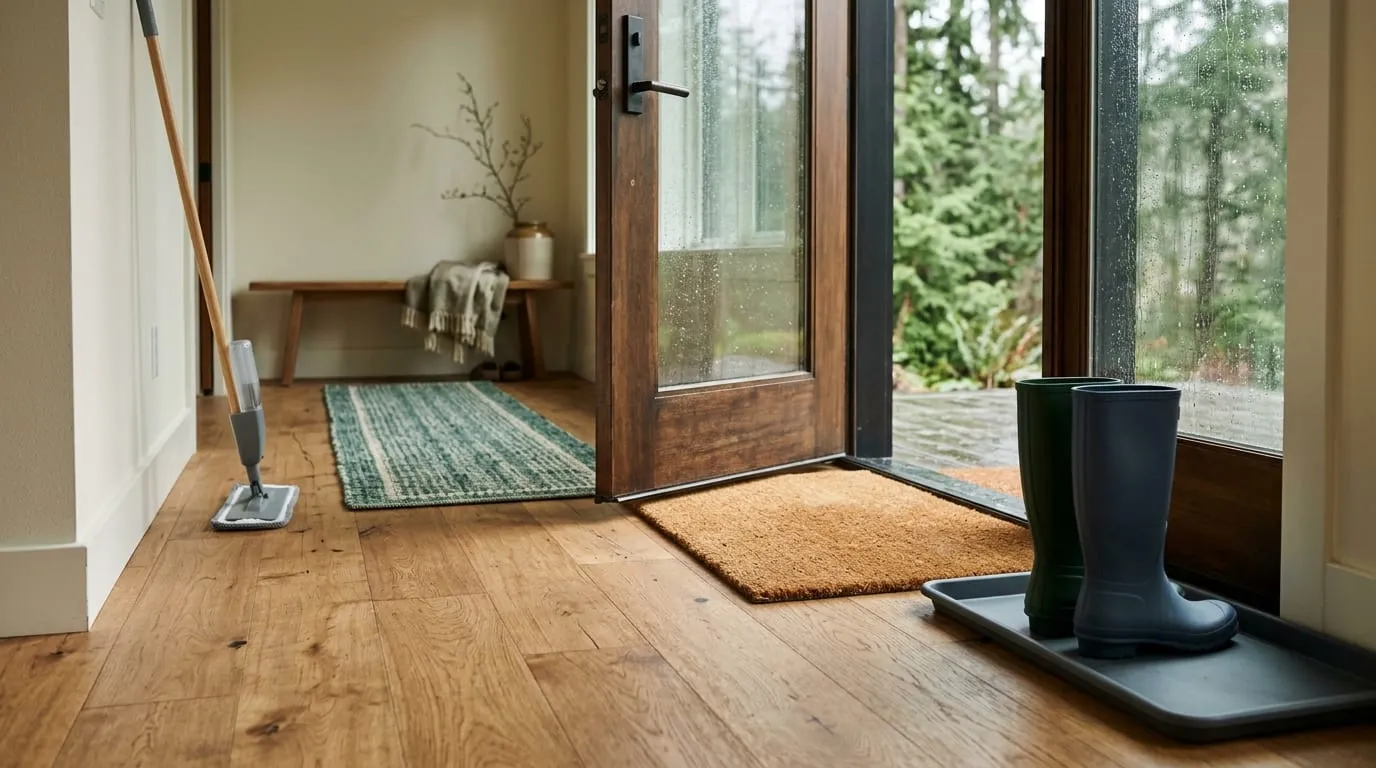
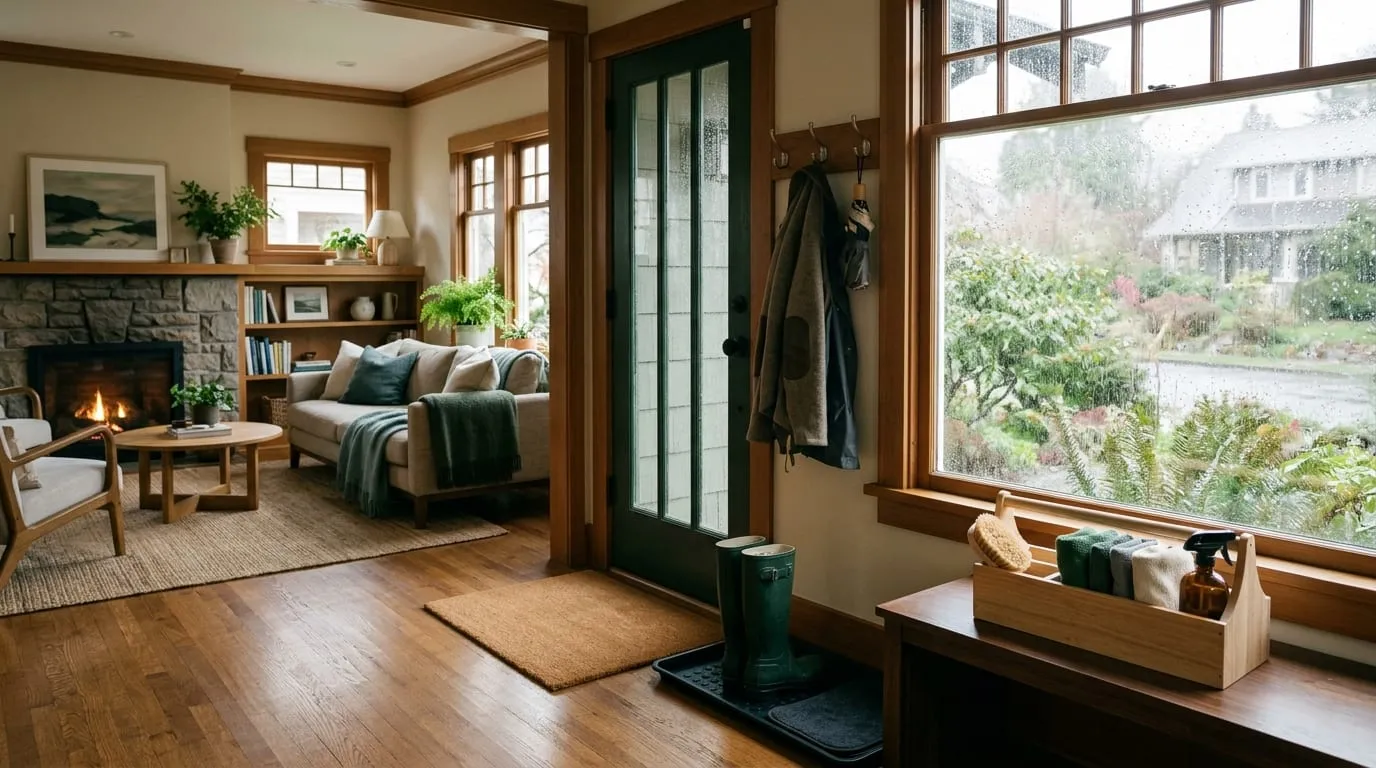
Use a coarse, durable scraper mat outside the door to knock off grit and wet leaves, then an absorbent mat inside long enough for two full steps. Add a boot tray for wet footwear and make shoes-off the default. Vacuum the indoor mat often and let it dry; a soggy mat stops absorbing and starts smelling.
Moisture control is cleaning
The EPA says the key to mold control is moisture control. It recommends keeping indoor humidity below 60 percent, ideally between 30 and 50 percent, and drying water-damaged areas within 24 to 48 hours of a leak or spill so mold does not grow. In practice, for a Seattle home in the wet season, that means:
- Run the bathroom fan during every shower and for a while after.
- Squeegee shower glass and tile after use.
- Wipe condensation off window glass and sills in the morning, especially in bedrooms.
- Use the range hood when cooking and boiling water.
- Do not dry laundry on racks in small, closed rooms without ventilation.
- Watch the hygrometer; if it stays high, a dehumidifier in the problem room helps.
The EPA also notes that for most small mold patches (under about 10 square feet) you can clean it yourself, while larger areas or mold tied to a hidden water problem call for more caution. Our guide to keeping your home clean during Seattle’s rainy season goes deeper on mildew, damp entries, and window condensation.
Ventilate when you clean
Closed-up winter houses hold fumes. The EPA advises increasing ventilation when using products that release volatile organic compounds, following label precautions, and never mixing household products unless the label directs it. Crack a window or run exhaust fans while you work.
Older homes and dust
Much of Seattle’s housing stock is old. The EPA says homes built before 1978 are more likely to have lead-based paint, and that dust from deteriorating paint is one of the most common sources of lead exposure. If your home is older and you see chipping paint on window sills or trim, wipe sills with a damp disposable cloth rather than dry-dusting them, and do not sand or scrape painted surfaces as part of cleaning.
Soft water
Seattle Public Utilities’ May 2026 quarterly analysis measured hardness between about 0.5 and 1.7 grains per gallon in its Cedar and Tolt supplies. By the USGS classification (0 to 60 milligrams per liter as calcium carbonate is soft), that is soft water. The upside: the USGS notes that hard water causes mineral buildup and poor soap performance, so Seattle homes see less heavy scale. The practical catch: soap works readily in soft water, so a little goes a long way, and extra product mostly leaves a dull film behind. Use less and rinse well. If your water comes from a different utility or a private well, check your own provider’s water quality report.
A worked example: one Saturday in a two-bedroom
Consider an illustrative scenario: a two-bedroom, one-bath Seattle apartment with hardwood floors, one cat, and a small entry, cleaned every two weeks. Here is how the order of operations plays out. The times are rough, not measured.
- Minutes 0 to 15. Walk every room with a basket and a trash bag. Strip both beds and start the washer. Load the dishwasher.
- Minutes 15 to 20. Spray the tub and toilet bowl with the bathroom cleaner and spray the inside of the microwave with all-purpose cleaner. Leave each for the time on its label.
- Minutes 20 to 45. Dust, top to bottom, in a loop: bedroom one, bedroom two, living room, kitchen tops, bathroom fixtures. Wipe switches and handles along the way.
- Minutes 45 to 65. Vacuum the whole apartment, including the cat tree, the sofa, and under the beds. Shake the entry mat outside.
- Minutes 65 to 105. Kitchen wet work: hood, cabinets, microwave, counters, stove, sink.
- Minutes 105 to 135. Bathroom: mirror, shower, grout line at the tub, counter, toilet, then squeegee and dry the faucet.
- Minutes 135 to 150. Move linens to the dryer, make the beds when they are done.
- Minutes 150 to 170. Mop from the back bedroom toward the front door with a barely damp flat mop. Finish at the entry, wipe the boot tray, empty the vacuum.
Total: just under three hours. A household that keeps up a short daily reset (dishes, a counter wipe, a quick squeegee) will see the kitchen and bathroom steps shrink noticeably over time.
Keeping it clean between full cleans
A full clean is easier when the house never gets far from clean. A light daily and weekly rhythm does most of the work:
- Daily: dishes done or loaded, counters and stovetop wiped, shower squeegeed, entry mat shaken if it is wet out.
- Daily in the wet season: wipe window condensation, run bathroom fans, hang wet coats where they can drip onto a tray.
- Weekly: the full room-by-room routine above, bedding changed, floors vacuumed and mopped.
- Monthly: vacuum vents and fan grilles, wipe baseboards and door frames, clean the dishwasher filter, wash mats.
- Seasonally: the deep-clean tasks.
How often each of those deeper tasks should happen depends on your household. Our article on how often to deep clean your home has a task-by-task frequency table and the triggers (pets, allergies, renovation, illness) that move a task up the calendar. If you live in an apartment, the apartment cleaning checklist turns this guide into a printable weekly and monthly list.
When the routine is not enough
Some homes outgrow a weekend routine: a new baby, a long work stretch, a recovery, or a house that has slipped too far to catch up on in one day. If you are weighing whether outside help makes sense, our guide to professional cleaning versus DIY walks through the trade-offs, Seattle house cleaning costs explains what drives the price, and how to choose a house cleaning service in Seattle covers the questions to ask before you hire anyone.
If you are cleaning because you are moving out of a rental, the standard is different. The Seattle apartment move-out cleaning checklist on our sister site, Seattle Move-Out Guide, covers what landlords typically inspect.
Common questions
Should I clean the kitchen or the bathroom first?
Either works, as long as each room is finished before you start the next. Many people do the kitchen first because it has the most grease and the most daily use, then end with bathrooms and floors so the wettest, dirtiest tasks come last.
Do I need to disinfect every surface every time I clean?
No. The CDC says routine cleaning with soap or detergent removes most germs, and that disinfecting is mainly worth it when someone in the home is sick or at higher risk. Sanitize surfaces that touched raw meat, and save disinfectant for high-touch spots during illness.
Why does my Seattle house feel dusty again two days after cleaning?
Usually because grit is still coming in on shoes, the vacuum is reblowing fine dust, or you dusted after vacuuming. Fix the entry first, vacuum after dusting, use a vacuum with good filtration, and check that your furnace filter is not overdue.
Is a steam mop safe for every floor?
No. Heat and moisture can damage some hardwood, laminate, and unsealed surfaces, and may void a flooring warranty. Check the floor manufacturer's care guide before using one, and see our wet-climate floor guide for a type-by-type breakdown.
How long should a full house clean take?
It depends on size, clutter, and how recently it was cleaned. Use the room estimates in this guide as a starting point, time yourself once, and plan around your own number rather than a generic one.
Sources and references
- A Brief Guide to Mold, Moisture and Your Home , U.S. Environmental Protection Agency Primary source Accessed November 15, 2026
- When and How to Clean and Disinfect Your Home , Centers for Disease Control and Prevention Primary source Accessed November 15, 2026
- Volatile Organic Compounds' Impact on Indoor Air Quality , U.S. Environmental Protection Agency Primary source Accessed November 15, 2026
- Reduce the Risk of Lead Exposure at Home , U.S. Environmental Protection Agency Primary source Accessed November 15, 2026
- Control Indoor Allergens to Improve Indoor Air Quality , Asthma and Allergy Foundation of America Accessed November 15, 2026
- Cleaning and Maintenance (Carpet for Homes) , The Carpet and Rug Institute Accessed November 15, 2026
- Quarterly Surface Water Analysis (samples collected May 19-20, 2026) , Seattle Public Utilities Primary source Accessed November 15, 2026
- Hardness of Water , U.S. Geological Survey Primary source Accessed November 15, 2026
See something out of date or wrong? Tell the editors. Read how we work in our editorial policy.