How to Keep Your Home Clean During Seattle's Rainy Season
Keep mud, damp, and mildew out of a Seattle home from October to April: entry systems, wet gear, floors, condensation, ventilation, laundry, and dehumidifiers.
The short answer
Stop water and grit at the door with a two-mat entry system and a wet gear station, dry floors and window condensation daily, run bathroom and kitchen fans every time, dry laundry with a vented dryer, and keep indoor humidity below 60 percent (ideally 30 to 50 percent), using a dehumidifier if a meter shows you need one.
- Seattle's wet season is long: NOAA's 1991-2020 normals for Sea-Tac show 39.34 inches of precipitation a year and about 156 days with measurable precipitation, with November, January, and December the wettest months.
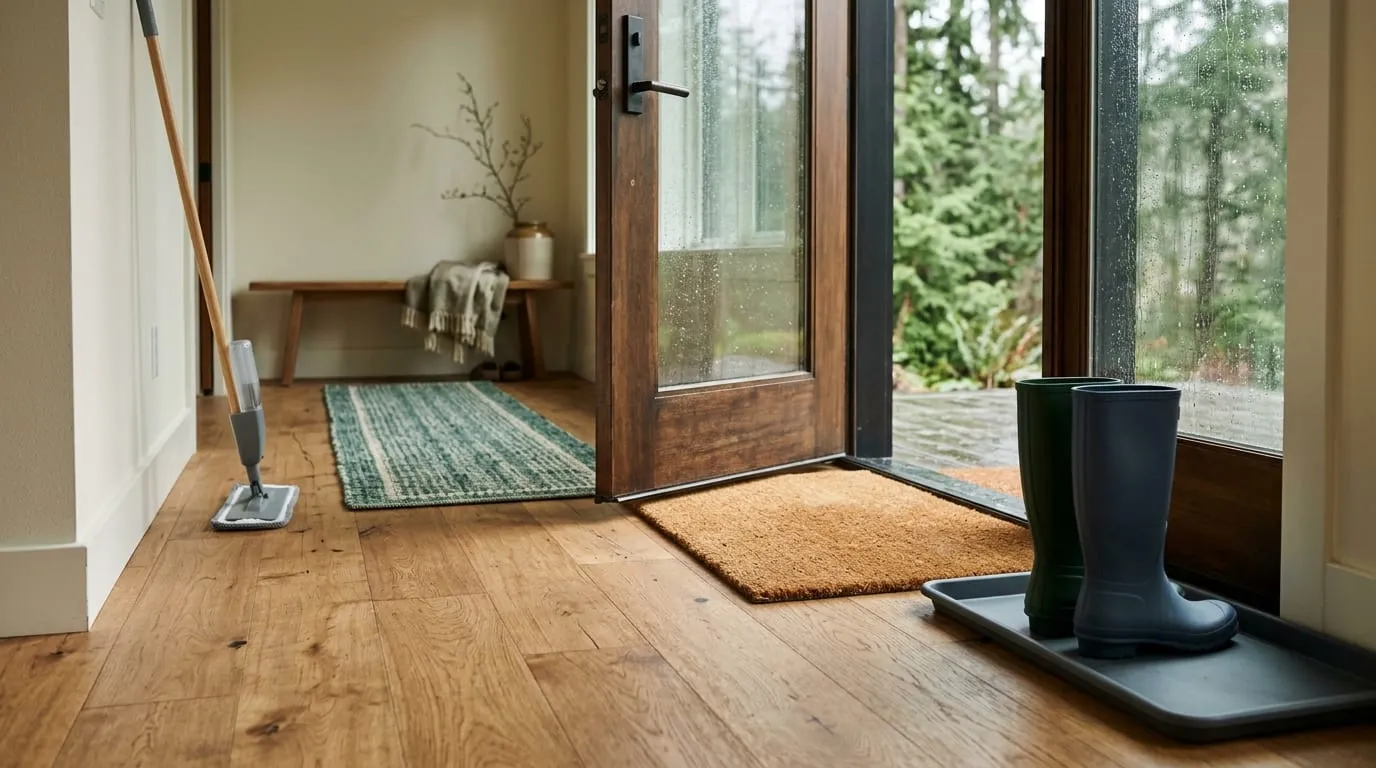
- Most rainy-season dirt comes through the front door. An outdoor scraper mat, an indoor absorbent mat, and a shoes-off boot tray catch most of it.
- Moisture is the real enemy. The EPA recommends keeping indoor humidity below 60 percent, ideally between 30 and 50 percent; a cheap humidity meter tells you where you stand.
- Wipe window condensation in the morning, run exhaust fans during and after showers and cooking, and pull furniture a few inches off exterior walls.
- Small mildew patches are a cleaning job. The EPA says areas under about 10 square feet are usually DIY; larger growth or water damage needs more.
From October through April, cleaning a Seattle home is less about dust and more about water. Rain and grit come in on shoes, dogs, and umbrellas; showers and cooking add moisture to a closed-up house; and cold windows and exterior walls collect condensation. This guide shows you how to stop dirt at the door, keep moisture under control, and catch mildew before it spreads, with a month-by-month calendar for the wet season.
How wet is the wet season, really?
According to NOAA’s 1991-2020 climate normals for Seattle-Tacoma International Airport, the area averages 39.34 inches of precipitation a year, with 156.2 days a year bringing at least 0.01 inch. That is less total rain than many East Coast cities, but it arrives as a long run of damp days rather than a few downpours. For a house, that means surfaces rarely dry out on their own.
| Month | Normal precipitation at Sea-Tac (inches) | What it means indoors |
|---|---|---|
| October | 3.91 | The switch: entry dirt and first condensation |
| November | 6.31 | Wettest month of the year |
| December | 5.72 | Wet, dark, windows closed |
| January | 5.78 | Wet, coldest windows, peak condensation |
| February | 3.76 | Still damp; check closets and corners |
| March | 4.17 | Mud season for yards and paths |
| April | 3.18 | Tapering; time to reset |
By comparison, NOAA’s normals show July at 0.60 inch and August at 0.97 inch. The cleaning routine that works in August will not hold up in November.
Build an entry system that stops dirt at the door
Most rainy-season mess comes in through one or two doors. Stopping it there is far easier than chasing it across the house.
The two-mat setup
- Outside: a scraper mat. A coarse mat (coir, rubber with raised nubs, or a rigid bristle mat) knocks off grit and wet leaves. Put it where people actually step, under cover if possible.
- Inside: an absorbent mat. A washable, rubber-backed mat long enough for two or three steps catches the water the scraper missed. One step on a small mat does little.
- Shoes off, on a tray. A boot tray with a lip keeps drips off the floor and makes cleanup one motion.
Shake or vacuum the outdoor mat weekly in the wet months and wash the indoor mat every week or two, following its care label. A mat that is saturated stops working and starts spreading water.
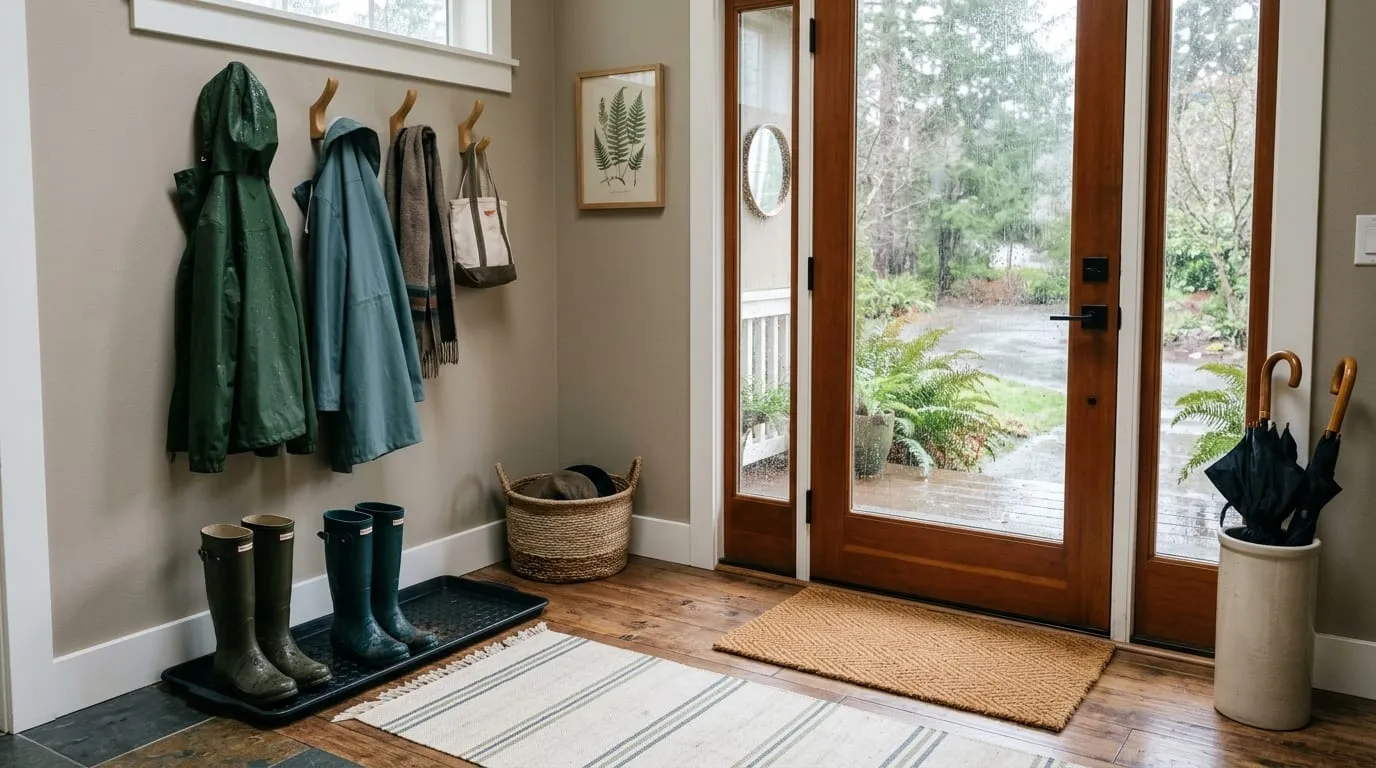
Wet gear station checklist
Set this up in the entry, mudroom, or the first few feet inside the door.
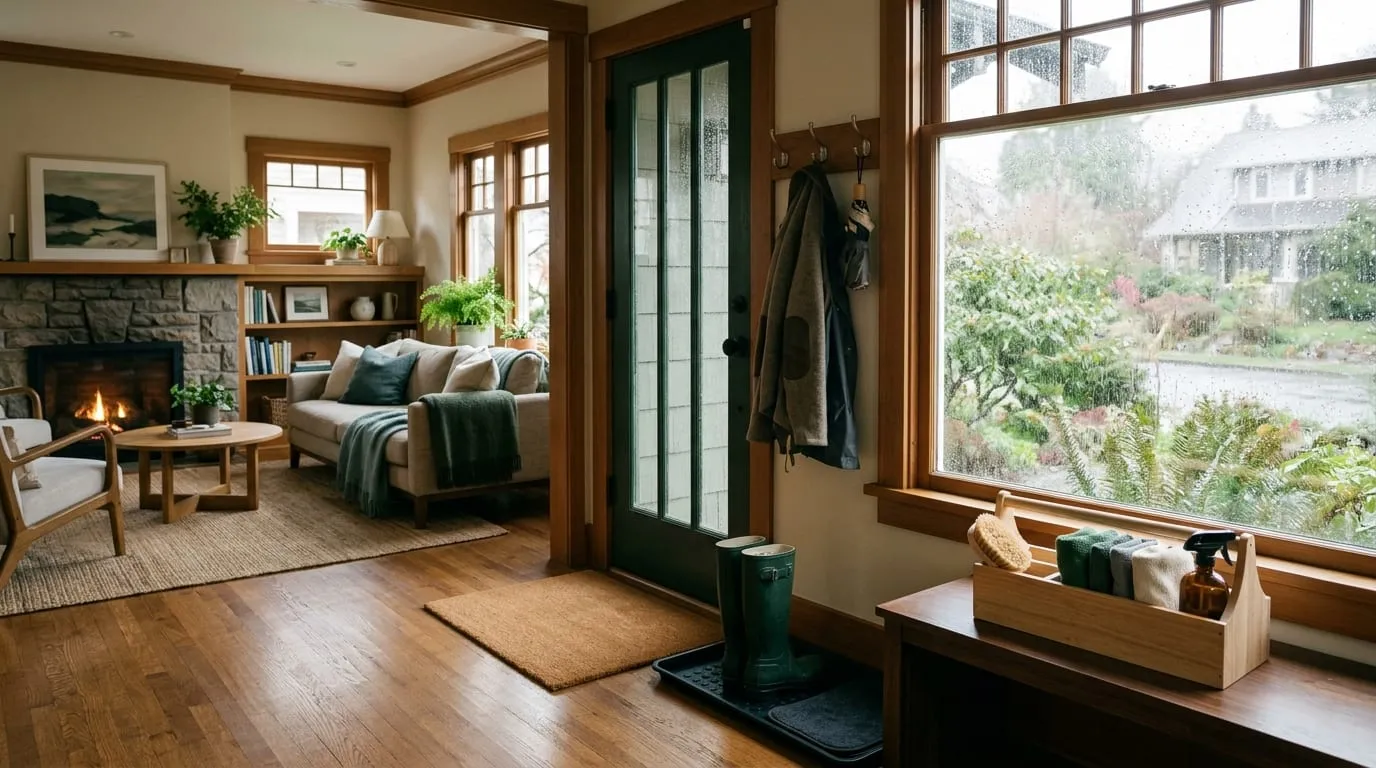
- Wall hooks with space between them so jackets can drip and dry without touching
- A boot tray with a raised edge
- An umbrella stand or bucket that can be emptied
- A basket for hats and gloves (not damp ones; let those dry first)
- An old towel on a hook for dogs and kids
- A small cordless vacuum or dustpan within reach
- A humidity meter if the entry is a closet or enclosed mudroom
Do not stuff wet coats into a closed closet. Let them dry on hooks first. Closets on exterior walls are classic spots for musty smells because, as the Washington State Department of Health notes, mold can grow where warm, moist air condenses on cooler wall surfaces, including inside cold exterior walls, behind dressers and headboards, and in closets where items are stored against walls.
Floors: keep grit and water moving out
Wet grit is abrasive. Tracked across hardwood, it dulls the finish; ground into carpet, it holds moisture.
- Vacuum entry zones daily in November through January. Two minutes with a cordless vacuum beats a weekly hour of scrubbing.
- Wipe puddles right away. On hardwood, standing water is the main risk; use a dry microfiber cloth, not a wet mop.
- Damp-mop, do not wet-mop. Wring the mop until it is barely damp, and let the floor dry before people walk on it.
- Rotate runners and rugs. Wash or replace entry runners when they smell musty.
For floor-by-floor detail, including what each surface tolerates, see our guide to cleaning hardwood and other floors in a wet climate.
Window condensation: the daily wipe
Cold glass and warm, damp indoor air make water. In January, many Seattle windows are wet every morning.
- Wipe each morning with an absorbent cloth or a small squeegee, starting at the top of the pane. The Washington State Department of Health advises checking around windows for condensation and water droplets and wiping them up right away so mold cannot start to grow.
- Dry the sill and track, where water pools. A rolled towel along a chronically wet sill buys time.
- Clean tracks monthly with a vacuum crevice tool, then a damp cloth. Dirt plus water becomes the black grime that feeds mildew.
- Open blinds and curtains during the day so air reaches the glass.
- Treat it as a signal. The EPA notes that condensation can be a sign of high humidity. If windows run with water daily, work on the moisture sources in the next sections rather than just wiping harder.
Bathrooms and kitchens: ventilate every time
Showers and cooking are the biggest moisture sources most homes have. The EPA recommends running the bathroom fan or opening a window when showering, and using exhaust fans or opening windows whenever cooking, running the dishwasher, or washing dishes.
- Run the bath fan during the shower and for a while after, until the mirror clears.
- Squeegee shower walls and hang towels spread out, not bunched.
- Leave the shower curtain extended so it dries flat.
- Turn on the range hood before the pan heats up, not after.
- Clean fan grilles monthly. A dusty grille moves less air.
The EPA also notes that if mold keeps reappearing in a shower or elsewhere in the bathroom, more ventilation and more frequent cleaning will usually prevent it from recurring, or at least keep it to a minimum.
Laundry: where indoor moisture hides
Drying clothes on racks indoors puts a lot of water into the air. ENERGY STAR’s dehumidifier guidance treats laundry drying as a “high-load” moisture condition.
- Use a dryer vented outdoors when you can. The EPA lists venting moisture-producing appliances such as clothes dryers to the outside among the ways to reduce humidity.
- Clean the lint filter after every load. ENERGY STAR calls this an important safety measure as well as an efficiency one.
- If you must air-dry indoors, use the bathroom with the fan running and the door closed, or a room with a dehumidifier.
- Leave front-loader doors open after a cycle so the gasket dries.
- Never leave wet laundry sitting in the machine overnight.
Humidity and dehumidifier basics
The EPA recommends keeping indoor humidity below 60 percent if possible, ideally between 30 and 50 percent. A small digital humidity meter (hygrometer) costs little and removes the guesswork. Put one in the main living area and one in the dampest room.
Reading the meter
| Reading | What to do |
|---|---|
| 30 to 50 percent | Keep doing what you are doing |
| 50 to 60 percent | Ventilate more: fans, brief window airing, no indoor laundry drying |
| Above 60 percent | Find the source; add a dehumidifier in that room |
| Damp spots on walls or floors | Treat as a moisture problem, not just a cleaning one |
Choosing and using a dehumidifier
ENERGY STAR sizes portable dehumidifiers by capacity in pints per day, based on the size of the space and how damp it is. Its guidance, in short:
- A space that feels damp with an intermittent musty odor (about 50 to 75 percent relative humidity) needs less capacity than one that consistently smells damp with damp spots on walls (about 75 to 90 percent), which needs less than one where walls or floors sweat or laundry is being dried (90 to 100 percent).
- When in doubt, ENERGY STAR advises that it is better to oversize than undersize.
- If the space usually stays below about 65 degrees Fahrenheit, as many basements and garages do, consider a model specified for lower temperatures, since frost can form on the coils.
- A drain hose to a floor drain saves emptying the bucket.
Keep the dehumidifier’s filter clean and empty and rinse the bucket regularly so it does not become its own mildew source.
Mildew: clean small spots, report big problems
Spotting black specks on caulk, grout, window frames, or the back of a closet is normal in a damp climate. Dealing with it promptly keeps it small.
- Small patches: the EPA says that if the moldy area is less than about 10 square feet (roughly a 3 foot by 3 foot patch), in most cases you can handle it yourself. Scrub hard surfaces with detergent and water, and dry them completely.
- Protect yourself: wear gloves and avoid touching mold with bare hands, as the EPA advises, and ventilate the room.
- Never mix products. If you use a mildew remover, follow its label for ventilation and dwell time, and use it alone. Our guide to cleaners, sanitizers, and disinfectants explains why.
- Do not paint or caulk over mold. The EPA notes that paint applied over moldy surfaces is likely to peel; clean and dry first.
- Bigger or recurring problems: if growth is larger than about 10 square feet, there has been significant water damage, or mold keeps returning after cleaning, the EPA points to more detailed remediation guidance. Renters should report leaks and recurring mold to the landlord in writing.
The Washington State Department of Health puts the principle simply: you cannot get rid of all mold spores in a home, but you can control mold growth by keeping your home dry. It also recommends moving large objects a few inches away from the inside of exterior walls to improve air circulation.
The rainy-season calendar, October to April
| Month | Main focus | Tasks |
|---|---|---|
| October | Set up | Wash or replace entry mats; set up the wet gear station; clean window tracks; test bath and kitchen fans; buy a humidity meter |
| November | Entry control | Vacuum entry daily; wash indoor mat every 1-2 weeks; check that downspouts send water away from the house |
| December | Moisture sources | Start the morning window wipe; move furniture off exterior walls; check closets for musty smells |
| January | Condensation peak | Wipe windows and sills daily; check humidity readings; empty and clean the dehumidifier bucket; scrub any small mildew spots |
| February | Hidden corners | Check behind beds, dressers, and in closet corners on exterior walls; wash shower curtain liner |
| March | Mud season | Deep clean entry floors and grout; wash coats and rain gear per care labels; clean boot trays |
| April | Reset | Wash windows inside; launder curtains; air out closets; store winter gear dry; plan a spring deep clean |
For a broader year-round routine, see how often to deep clean.
Worked example: one week in January (illustrative)
The following is an illustrative scenario, not a measurement.
Consider a 1920s two-bedroom house in Wallingford with two adults and a dog, a single entry door, a bathroom without a window, and laundry in a cool basement.
- Entry: they add a scraper mat outside, a long washable runner inside, a boot tray, and a dog towel on a hook. Daily: a two-minute vacuum of the first six feet inside the door.
- Windows: every morning, one person wipes the four worst windows with a squeegee and a cloth, about five minutes. Sills get a dry wipe.
- Bathroom: the fan runs during showers and until the mirror clears. They add a squeegee to the shower and stop bunching towels on one hook.
- Laundry: they stop drying sweaters on a rack in the bedroom; delicate items now dry in the bathroom with the fan on.
- Basement: a humidity meter shows readings above 60 percent. They add a dehumidifier rated for low temperatures, routed to the floor drain, and pull storage boxes a few inches off the foundation wall.
- Weekly: one hour on floors, bathroom, and kitchen, plus washing the entry runner and dog towels.
After two weeks, the bedroom windows are dry by midday and the musty smell in the basement closet is gone. The routine adds about ten minutes a day, almost all of it at the door and the windows.
When to bring in help
Most rainy-season work is daily habit, not heavy cleaning. A professional deep clean is useful at the start of the season (to clear window tracks, vents, and baseboards before condensation season) or in spring to reset after months of closed windows. Mold that is extensive, keeps returning, or comes with water damage is a job for a remediation professional or, for renters, the landlord, not a house cleaner.
Common questions
Should I open windows in winter if it is raining outside?
Briefly, yes, especially while cooking, showering, or drying anything indoors. Cold outdoor air holds less moisture than warm indoor air, so a short airing usually helps even on a wet day. Ten minutes with a window cracked on each side of the home moves a lot of damp air out without chilling the house much.
Is a little black mildew on window frames dangerous?
A small patch from condensation is common in damp-climate homes and is a routine cleaning job: scrub with detergent and water, dry it, and fix the moisture source by wiping condensation daily. Wear gloves, keep the area ventilated, and do not mix cleaning products. If it returns quickly, spreads, or the frame is soft, report it to your landlord or call a professional.
What size dehumidifier do I need for a damp Seattle basement?
ENERGY STAR sizes portable units in pints per day by how damp the space is and how big it is. A space that smells musty some of the time needs less capacity than one with damp spots on the walls. If the basement stays below about 65 degrees, look for a model rated for low temperatures.
Do I need to clean differently if I have a dog in the rainy season?
Mostly you need a stop point at the door. Keep an old towel on a hook at dog height, wipe paws and belly before the dog leaves the entry mat, and wash those towels hot every few days so they do not turn musty. Vacuum the entry zone daily during the wettest months.
Sources and references
- Annual/Seasonal Climate Normals 1991-2020, Seattle-Tacoma International Airport (USW00024233) , NOAA National Centers for Environmental Information Primary source Accessed November 15, 2026
- Monthly Climate Normals 1991-2020, Seattle-Tacoma International Airport (USW00024233) , NOAA National Centers for Environmental Information Primary source Accessed November 15, 2026
- A Brief Guide to Mold, Moisture and Your Home , U.S. Environmental Protection Agency Primary source Accessed November 15, 2026
- Mold Cleanup in Your Home , U.S. Environmental Protection Agency Primary source Accessed November 15, 2026
- Mold , Washington State Department of Health Primary source Accessed November 15, 2026
- Dehumidifiers , ENERGY STAR (U.S. EPA and Department of Energy) Primary source Accessed November 15, 2026
- Clothes Dryers , ENERGY STAR (U.S. EPA and Department of Energy) Primary source Accessed November 15, 2026
See something out of date or wrong? Tell the editors. Read how we work in our editorial policy.