How Often Should You Deep Clean Your Home?
A task-by-task deep cleaning schedule (daily to yearly), plus the triggers that move tasks up: pets, allergies, kids, renovation dust, and illness.
The short answer
As a working rule, most homes benefit from a full deep clean every three to six months, with some tasks on their own clocks: carpets professionally deep cleaned every 12 to 18 months per the Carpet and Rug Institute, and carpets and upholstery vacuumed weekly per the EPA. Pets, allergies, small children, renovation dust, and illness in the house all shorten those intervals.
- Think in tasks, not one big date: some deep-clean jobs are monthly, some quarterly, and a few are yearly.
- The EPA's asthma guidance calls for vacuuming carpets and furniture every week and suggests a vacuum with a HEPA filter.
- The Carpet and Rug Institute recommends professional carpet deep cleaning every 12 to 18 months, or more often if needed.
- Allergies, pets, toddlers, renovation, and illness are triggers that move specific tasks up the calendar, not reasons to deep clean everything more often.
- A rotating schedule (one zone per week) usually beats a single exhausting weekend.
As a working rule, most homes benefit from a full deep clean every three to six months, but that one number hides the useful part. A deep clean is really a set of tasks, and each has its own clock: some belong on the calendar monthly, some quarterly, and a few only once a year. Carpets are a good example. The EPA’s asthma guidance says to vacuum carpets and furniture every week, and the Carpet and Rug Institute recommends a professional deep cleaning every 12 to 18 months.
This guide gives you a task-by-task frequency table, explains the household triggers that move tasks up the calendar, and shows how to turn it all into a rotation you can actually keep.
What counts as a deep clean
A regular clean keeps visible surfaces in good shape: dusting what you can see, vacuuming open floor, wiping counters, scrubbing the toilet and tub. Our Seattle house cleaning guide covers that routine room by room.
A deep clean goes where the routine does not:
- Behind and under things: the refrigerator, the stove, the washer and dryer, beds, and sofas.
- Inside things: the oven, the fridge, the dishwasher filter, cabinets, drawers, and closets.
- Above things: tops of cabinets, ceiling fan blades, light fixtures, vents, and door frames.
- Things that soak up soil: carpet pile, upholstery, mattresses, curtains, and pillows.
- Things that build up slowly: grout, caulk lines, window tracks, baseboards, and range hood filters.
None of these get dirty fast, which is exactly why they get forgotten. Left long enough, they become the source of dust, odors, and mildew that make a freshly cleaned room still feel off.
The frequency table: deep cleaning by task
The table below is a starting point for a typical household without special triggers. Intervals marked with a source come from that organization; the rest are editorial guidance based on how fast each area tends to build up. Adjust them to your home using the triggers in the next section.
| Task | Typical interval | Why that interval | Move it up if |
|---|---|---|---|
| Wipe counters, stovetop, sink; dishes done | Daily | Food residue hardens and attracts pests | Always daily |
| Squeegee shower glass and tile | Daily (after use) | Removes water that feeds mildew and spotting | Always daily |
| Vacuum carpets and upholstered furniture | Weekly (EPA) | House dust can contain asthma triggers | Pets, allergies, crawling babies |
| Wash bedding in hot water | Weekly (EPA, AAFA) | Dust mites live in bedding | Dust mite allergy (AAFA: 130 degrees F or hotter) |
| Mop hard floors, clean bathrooms fully | Weekly | Normal traffic and use | Kids, pets, wet-season mud |
| Vacuum vents, returns, and fan grilles | Monthly | Dust collects and recirculates | Allergies, after renovation |
| Wipe baseboards, door frames, switch plates | Monthly | Scuffs and fingerprints build slowly | Toddlers, pets that rub walls |
| Clean dishwasher filter and microwave interior | Monthly | Food debris and odor | Heavy cooking households |
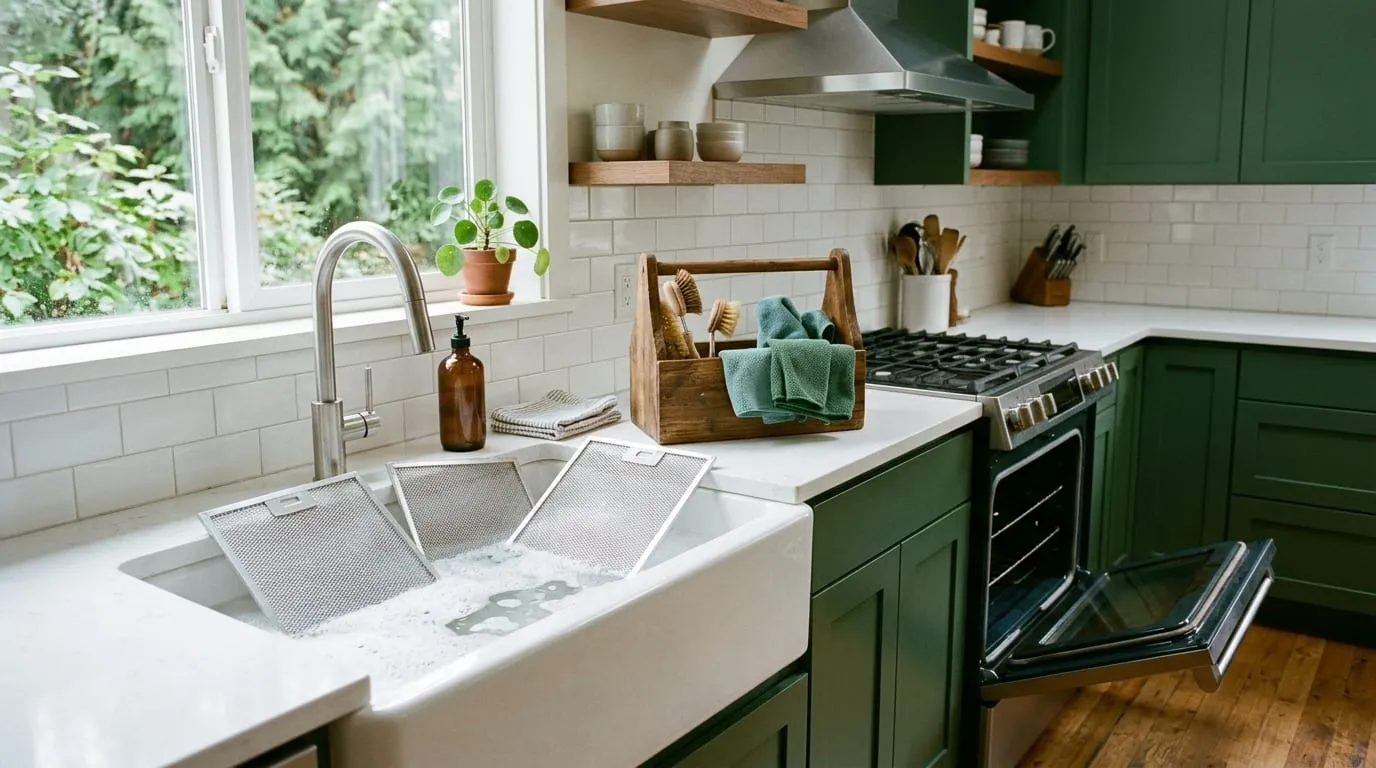
| Degrease range hood filter | Monthly to quarterly | Grease builds with cooking frequency | Frequent frying or searing |
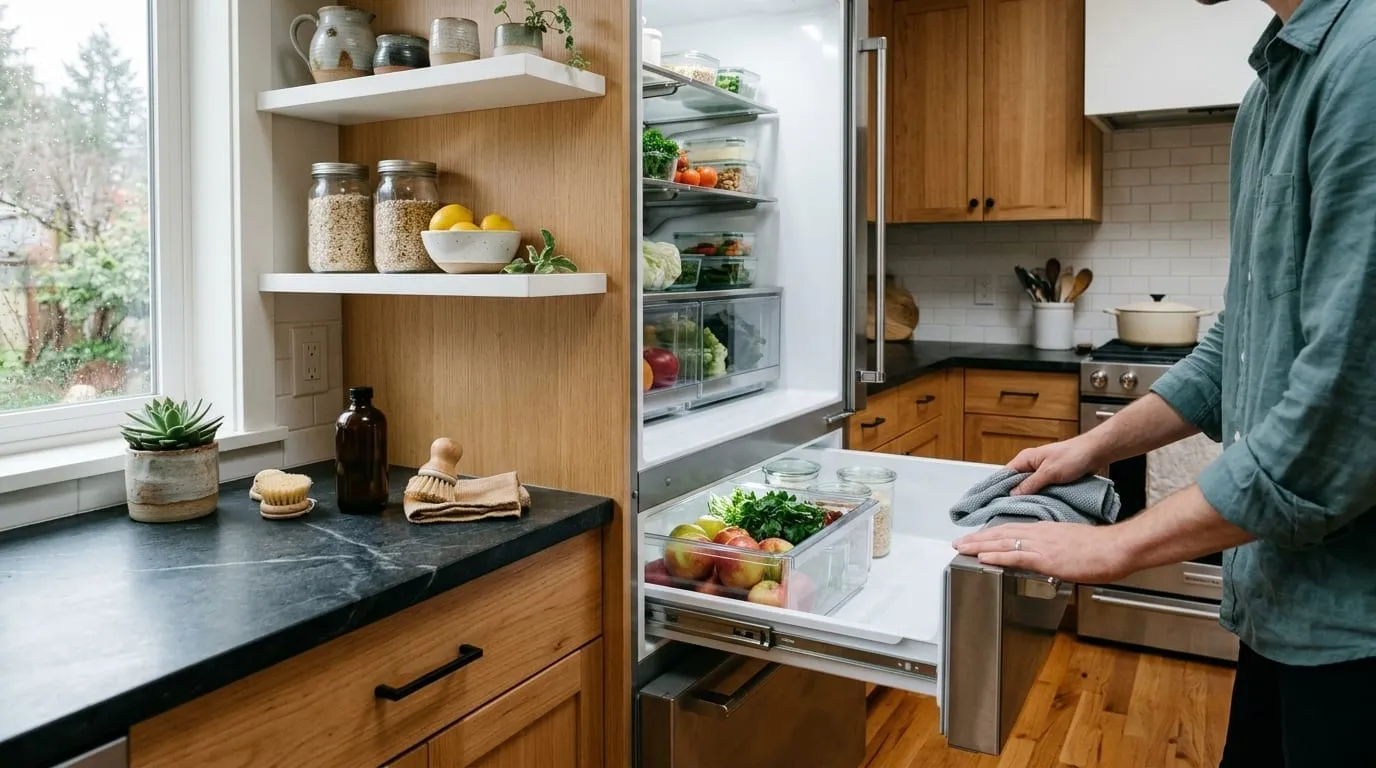
| Clean inside the refrigerator | Quarterly | Spills and expired food | Any spill of raw meat juices, right away |
| Wash windows inside, sills, and tracks | Quarterly | Condensation leaves grime in tracks | Wet-season condensation, visible mildew |
| Move furniture and vacuum underneath | Quarterly | Dust and pet hair collect out of sight | Pets, allergies |
| Scrub grout and check caulk | Quarterly | Grout absorbs moisture and soil | Visible mildew, poor bathroom ventilation |
| Clean oven interior | Quarterly to twice a year | Depends on cooking and spills | Smoke when preheating |
| Vacuum and rotate mattress, wash pillows | Twice a year | Dust and skin cells accumulate | Allergies |
| Wash or vacuum curtains and blinds | Twice a year | Fabric holds dust | Allergies, smoke, nearby construction |
| Pull out fridge, stove, washer, dryer and clean behind | Once a year | Lint, dust, and lost food | Pests, odors |
| Wipe inside of all cabinets and closets | Once a year | Slow dust and crumb buildup | Moths, pantry pests |
| Professional carpet deep cleaning | Every 12 to 18 months (CRI) | Removes embedded soil vacuuming cannot | Pets, heavy traffic, visible matting |
For a weekly and monthly list sized for a smaller space, see the apartment cleaning checklist.
Triggers that move tasks up the calendar
The most common mistake is treating a trigger as a reason to deep clean everything more often. A pet does not make your cabinets dirtier. Triggers move specific tasks, so match the response to the cause.
Pets
Pets add hair, dander, tracked-in dirt, and the occasional accident.
- Vacuum carpets and upholstery more than once a week during shedding seasons. The Carpet and Rug Institute specifically advises vacuuming more often to capture pet hair and dander.
- Move furniture and vacuum underneath monthly instead of quarterly; that is where hair drifts.
- Wash pet bedding on the same weekly schedule as your own.
- For urine accidents on carpet, the Carpet and Rug Institute says not to use a steam cleaner, because heat sets the stain and the smell. Extract with a wet vacuum and rinse with cool water instead.
- Expect to need professional carpet cleaning toward the shorter end of the 12 to 18 month range, or sooner. CRI notes that quick spot cleanups do not take the place of periodic deep cleaning.
Allergies and asthma
For a household member with allergies or asthma, the bedroom and soft surfaces matter most.
- The EPA recommends washing bedding in hot water once a week, using dust-proof covers on pillows and mattresses, vacuuming carpets and furniture every week, dusting often with a damp cloth, and using a vacuum with a HEPA filter on carpet and fabric-covered furniture.
- The EPA also advises vacuuming when the person with asthma is not around, since vacuuming stirs up dust.
- The Asthma and Allergy Foundation of America recommends washing bedding, uncovered pillows, and stuffed toys in water at 130 degrees Fahrenheit or hotter each week, vacuuming once or twice a week, and choosing a vacuum that does not put dust back into the air. AAFA also notes that reducing humidity decreases dust mites and mold growth.
- Move vents, curtains, blinds, and under-furniture vacuuming from quarterly or twice-yearly to monthly.
Small children
Toddlers live on the floor and put their hands in their mouths.
- Floors in play areas move from weekly to every few days.
- Wipe low surfaces (lower cabinet fronts, baseboards, the bottom of the fridge door, window sills within reach) monthly instead of a couple of times a year.
- Washable toys get washed on a set cycle; the EPA’s asthma guidance suggests choosing stuffed toys that can be washed and drying them completely.
- If your home was built before 1978, keep reading the renovation section below. The EPA says these homes are more likely to have lead-based paint, and that dust from it is one of the most common sources of lead exposure in homes.
Renovation, repairs, or nearby construction
Construction dust is fine, it travels, and it settles on top of everything for days.
- Plan a whole-house deep clean after the work is done, not during it. Then repeat the vent, curtain, and top-of-surface dusting tasks a couple of weeks later, once the dust that was still in the air has settled.
- Replace or check the furnace filter after the work wraps up.
- In homes built before 1978, the EPA’s lead guidance applies: wet mop floors and hard surfaces, use a vacuum with a HEPA filter where there is visible dust or debris from chipping or flaking paint, do not dry sweep, and do not shake or beat carpets and rugs. For renovation, repair, or painting projects in these homes, the EPA points homeowners to lead-safe certified contractors.
After illness in the household
When someone has been sick, the goal is targeted disinfection, not a full deep clean.
- Clean first, then disinfect high-touch surfaces: door handles, faucet handles, light switches, toilet flush handles, remotes, and phones (following the device maker’s instructions for electronics).
- The EPA distinguishes three steps: cleaning removes germs and dirt with soap or detergent, sanitizing reduces bacteria, and disinfecting kills viruses and bacteria. With any EPA-registered product, follow the label and pay attention to contact time, which is how long the surface must stay wet.
- Wash the sick person’s bedding and towels once they are recovered.
- Never combine products to make them stronger. The Washington State Department of Health warns not to mix bleach with ammonia, acids, or other cleaners, because the combinations release toxic gases. Our guide to cleaners, sanitizers, and disinfectants covers what to use where.
Moisture problems and mildew
In a damp climate, moisture is its own trigger. If you see mildew on grout or window tracks, move those tasks to monthly until the source is fixed. The EPA’s mold guidance is clear that the key to mold control is moisture control: keep indoor humidity below 60 percent (ideally 30 to 50 percent) and dry water-damaged areas within 24 to 48 hours. Our rainy season cleaning guide goes deeper on Seattle’s wet months.
How to turn the table into a schedule you will keep
A single annual deep-clean weekend is exhausting, and it is easy to skip. A rotation spreads the work out so nothing goes more than a few months untouched.
Option 1: one zone per week
Divide the house into four zones and deep clean one zone each week on top of your normal routine. Every zone gets a deep clean roughly once a month, and the quarterly tasks fall into place naturally.
- Week 1: kitchen. Fridge interior, range hood filter, microwave, dishwasher filter, one or two cabinet shelves.
- Week 2: bathrooms. Grout, caulk check, exhaust fan grille, behind the toilet, medicine cabinet.
- Week 3: bedrooms. Under the bed, mattress vacuum, curtains or blinds, closet floor.
- Week 4: living areas and entry. Under the sofa, vents, baseboards, window tracks, entry mats.
Option 2: seasonal sessions
If you prefer bigger blocks, schedule four sessions a year and assign the quarterly tasks to each, with the annual tasks spread across them. In Seattle, it makes sense to put windows, tracks, and mildew-prone areas at the start of the wet season in fall and again in spring, when condensation season ends.
Option 3: trigger-driven
Keep the weekly routine and the annual tasks fixed, and let triggers decide everything in between. This works for small, low-traffic homes, but it depends on you noticing problems, so it is the easiest to let slide.
A worked example: one household’s adjusted schedule
Consider an illustrative household: a three-bedroom house in Seattle built in the 1950s, with wall-to-wall carpet in the bedrooms, two adults, a four-year-old, a shedding dog, and one adult with a dust mite allergy. Here is how the baseline table changes for them.
| Task | Baseline | Adjusted | Trigger |
|---|---|---|---|
| Vacuum carpets and upholstery | Weekly | Twice a week, HEPA vacuum | Dog, allergy |
| Wash bedding | Weekly | Weekly at 130 degrees F or hotter | Allergy (AAFA) |
| Vacuum under furniture | Quarterly | Monthly | Dog, allergy |
| Wipe low surfaces and sills | Monthly | Every two weeks | Four-year-old |
| Vents and fan grilles | Monthly | Monthly (unchanged) | None |
| Window tracks and sills | Quarterly | Monthly in the wet season, damp wipe | Condensation, older paint |
| Professional carpet cleaning | Every 12 to 18 months | About every 12 months | Dog |
| Fridge interior | Quarterly | Quarterly (unchanged) | None |
Two notes on the example. First, because the house predates 1978, the adjusted schedule uses damp wiping on sills and trim rather than dry dusting, following the EPA’s lead guidance. Second, most of the deep-clean list did not change at all. The triggers added maybe an hour a week, concentrated on floors, beds, and low surfaces, which is far less than deep cleaning the whole house monthly would cost.
Signs your home is overdue
Calendars drift. These signs mean a deep clean is due regardless of the date:
- Dust reappears on surfaces within a day or two of dusting.
- A musty smell in a closet, bathroom, or under a sink.
- Gray or black spots in grout or along caulk lines.
- Visible traffic lanes or matting in carpet.
- Grease that feels tacky on cabinet fronts near the stove.
- Smoke or a burnt smell when you preheat the oven.
- More allergy symptoms at home than elsewhere.
- You cannot remember the last time you pulled out the fridge.
If three or more apply, do a full top-to-bottom deep clean once, then start a rotation so you do not end up here again. The kitchen deep cleaning guide breaks down the biggest single room step by step.
When a deep clean is worth hiring out
A first deep clean in a home that has gone a year or more without one is the hardest session to do yourself, because every task is at its worst at once. Once a home is caught up, the rotation above is very manageable for most people.
If you are weighing it, our guide to professional cleaning versus DIY walks through the trade-offs. If you decide to hand off the catch-up session, Sweepless in Seattle, which publishes this guide, offers deep cleaning in Seattle and on the Eastside; whoever you hire, our guide to choosing a house cleaning service in Seattle covers what to ask first.
Moving out is a separate job with a landlord’s standard to meet. Our sister site’s Seattle apartment move-out cleaning checklist covers that.
Common questions
Is a deep clean the same as spring cleaning?
Close, but spring cleaning is a once-a-year tradition, while a deep clean is any session that goes past surface upkeep into the places routine cleaning skips. Many households do a big one in spring and smaller rotating zones the rest of the year.
How long does a deep clean take compared with a regular clean?
Usually two to three times as long for the same space, because you are moving furniture, emptying appliances, and cleaning surfaces that have collected months of buildup. A first deep clean in a neglected home takes longest; later ones go faster if you keep the rotation going.
Do renters need to deep clean on the same schedule as owners?
The dirt does not care who holds the deed, so the same intervals apply to daily life in a rental. Moving out is a different job with a landlord's standard to meet, which our sister site covers in its move-out cleaning checklist.
Can I skip vacuuming weekly if I have hard floors?
Hard floors still collect grit and dust that gets ground into the finish and stirred into the air, so a weekly pass with a vacuum or dust mop remains a good baseline. Rugs and upholstered furniture on top of those floors need weekly vacuuming too.
Should I deep clean before or after a holiday gathering?
Do the visible, high-impact zones (kitchen, bathrooms, entry, floors) a day or two before, and save inside-of-cabinet and behind-appliance tasks for afterward, when the cleanup is happening anyway.
Sources and references
- Asthma Triggers: Gain Control , U.S. Environmental Protection Agency Primary source Accessed November 15, 2026
- Control Indoor Allergens to Improve Indoor Air Quality , Asthma and Allergy Foundation of America Accessed November 15, 2026
- Cleaning and Maintenance (Carpet for Homes) , The Carpet and Rug Institute Accessed November 15, 2026
- A Brief Guide to Mold, Moisture and Your Home , U.S. Environmental Protection Agency Primary source Accessed November 15, 2026
- Reduce the Risk of Lead Exposure at Home , U.S. Environmental Protection Agency Primary source Accessed November 15, 2026
- What's the difference between products that disinfect, sanitize, and clean surfaces? , U.S. Environmental Protection Agency Primary source Accessed November 15, 2026
- Dangers of Mixing Bleach with Cleaners , Washington State Department of Health Primary source Accessed November 15, 2026
See something out of date or wrong? Tell the editors. Read how we work in our editorial policy.