How to Clean an Oven: Self-Clean, Steam Clean, and by Hand
Compare self-clean, steam clean, baking soda paste, and oven cleaner, then clean racks, door glass, and knobs safely, with pet, ventilation, and manual cautions.
The short answer
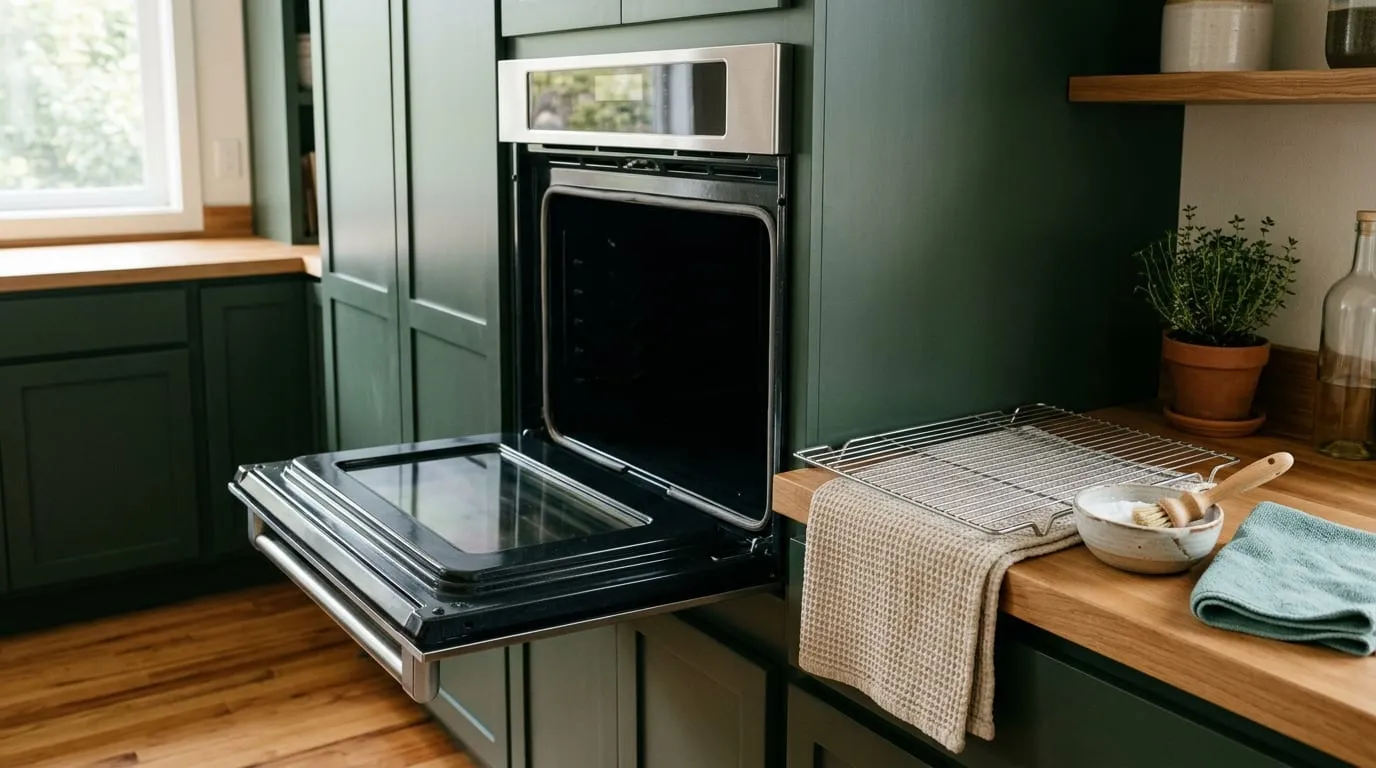
Match the method to the mess and to your manual: run the self-clean cycle for heavy, baked-on soil if your oven has one, use a steam-clean cycle for light, recent spills, and clean by hand with a baking soda paste (or an oven cleaner the manual allows) when there is no cycle or you want to avoid the heat and smoke. Always take the racks out first, ventilate the kitchen, keep pets and especially birds away during self-clean, and never use commercial oven cleaner inside a self-cleaning oven.
- Self-clean (pyrolytic) cycles heat the locked oven to around 800 degrees Fahrenheit and turn residue to ash; Whirlpool lists cycles of about 1.5 to 3 hours, and up to 6 on some models.
- Steam clean uses about a cup of water and roughly an hour, and is meant for light soil between deeper cleans.
- A baking soda paste (Whirlpool suggests 1/2 cup baking soda to 3 tablespoons water) can sit from 20 minutes to overnight, or 12 to 24 hours on stubborn spots.
- Whirlpool says not to use commercial oven cleaners or chemicals on self-cleaning ovens, and to move pets, especially birds, to another closed, ventilated room during self-clean.
- Take racks out before self-cleaning; Whirlpool warns they can be damaged by the heat. Soak them in soapy water and scrub instead.
The best way to clean an oven depends on two things: how dirty it is, and what your manual says your oven can handle. For heavy, baked-on grime, a self-clean cycle does most of the work with heat. For a light, recent spill, a steam-clean cycle is quicker. With no cleaning cycle, or if you would rather avoid hours of high heat and smoke, a baking soda paste and some patience clean nearly any oven by hand, and a commercial oven cleaner is an option only where your manual allows it. Whatever you choose, take the racks out first, ventilate, keep pets away, and never put commercial oven cleaner inside a self-cleaning oven.
This guide goes deeper than the oven section of our kitchen deep cleaning guide: a method-by-method comparison, step-by-step instructions, the racks, door glass, and controls, and what not to do.
Compare the four methods
| Method | How it works | Best for | Time | Main cautions |
|---|---|---|---|---|
| Self-clean (pyrolytic) | Door locks; oven heats to around 800 F and turns soil to ash | Heavy, baked-on grease and spills | About 1.5 to 3 hours of cycle plus cool-down, up to 6 on some models, per Whirlpool | Remove racks; smoke and odor; stay home; move pets and birds; no oven cleaner inside |
| Steam clean | About a cup of water on the oven floor turns to steam to soften soil | Light, recent spills between deep cleans | Around an hour including cool-down | Will not shift heavy buildup; wipe out water afterward |
| Baking soda paste by hand | Mildly abrasive, alkaline paste softens grime as it sits | Any oven, especially those without a cycle | 20 minutes to overnight dwell, plus 30 to 60 minutes of wiping | Slow; keep paste off the door gasket; rinse well |
| Commercial oven cleaner | Strong chemical cleaner dissolves baked-on grease | Ovens whose manual permits it, with heavy soil | Dwell time per the label | Not for self-cleaning ovens; ventilate; follow label PPE; never near bleach |
The times in the self-clean and steam rows come from Whirlpool’s guidance and vary by model; the hand-cleaning wipe-off time is our rough planning estimate.
Before you start: identify your oven
Find your owner’s manual (search the model number, usually on a label visible when the door or storage drawer is open). It answers the questions that decide everything else:
- Does it have a self-clean cycle, a steam-clean cycle, both, or neither? The control panel usually says, but the manual tells you how the cycle runs and what to remove.
- Are the racks self-clean safe? Whirlpool’s instructions are to remove them.
- What can touch the interior? Some manuals allow a specific oven cleaner; Whirlpool says commercial cleaners are not advisable on self-cleaning oven interiors.
- Is there a special coating? Older continuous-clean ovens and some newer interiors have coatings that harsh cleaners or abrasives can ruin. If the manual describes a special finish, use only what it permits.
Whichever method you use, start with a cool oven, take out the racks, the broiler pan, any thermometer, and anything stored in the drawer, and scrape out loose crumbs and charred bits.
Method 1: the self-clean cycle
A self-cleaning oven locks its door and heats far above cooking temperature. Whirlpool describes temperatures upward of 800 degrees Fahrenheit, which reduce food residue to ash in a process called pyrolytic cleaning.
How to run it
- Empty the oven completely. Whirlpool’s instructions are to remove everything, including racks, because residue on racks causes extra smoke and the racks can be damaged by the heat. On a range, clear the cooktop and the storage drawer too.
- Wipe out loose soil. Wipe the interior and frame with a damp cloth, avoiding the door gasket so it still seals properly. Remove pots, pans, and any aluminum foil.
- Ventilate. Make sure the oven vent is uncovered, turn on the range hood fan, and open windows. Whirlpool says this helps clear heat, odors, and smoke.
- Move pets. Whirlpool says to move pets, especially birds, to another closed and ventilated room, or outside in a cage, until cleaning finishes, and notes that pets’ senses of smell are more sensitive than ours.
- Choose the cycle. Some ovens offer light, moderate, and heavy settings. Whirlpool lists a light setting at around 2 hours and moderate or heavy closer to 3 or 4; a full cycle on its ranges can run 2.5 to 4.5 hours.
- Stay home. Whirlpool says not to leave the oven unattended during self-clean, to keep children away, and that no one should touch the oven while it cleans, because it can cause burns.
- Wait, then wipe. The door unlocks after the oven cools to cooking temperature, but wait until it is completely cool before wiping out the ash with a damp cloth. A heavily soiled oven may need a longer or second cycle.
Practical notes
- Run it before things get bad. Whirlpool recommends self-cleaning before excessive soil builds up, to avoid heavy smoke and fumes.
- Pick your timing. Many people choose a mild, dry day when windows can stay open. In a Seattle November that may mean waiting for a break in the rain, or running the hood fan on high the whole time.
- Plan around holidays. The oven is out of action for hours, so do not start a cycle the morning you need to roast something.
Method 2: the steam-clean cycle
Steam cleaning is a lighter, faster option. Some brands give it their own name, so check your manual for the exact steps.
- Remove racks and loose debris and let the oven cool.
- Add water. Whirlpool’s description is to pour around a cup of water onto the floor of the oven, then select the steam-clean cycle.
- Let the cycle run. Whirlpool says steam cycles take around an hour including cool-down, and temperatures typically top out around 400 degrees Fahrenheit. The door does not lock.
- Wipe out water and soil with a wet cloth once the cycle ends. Expect to do more wiping than after self-clean.
Steam is designed for light soil between heavier cleanings. It will soften a fresh cheese drip, but not years of baked-on grease. If steam does not move it, switch to the paste method or a self-clean cycle.
Method 3: by hand with baking soda paste
This works in any oven, uses no harsh chemicals, and is the safest choice if you are unsure what your interior can take. It is slow, so start it the night before.
- Make the paste. Whirlpool suggests 1/2 cup baking soda with 3 tablespoons of water for a thin, spreadable paste. A large or very dirty oven may need a double batch.
- Spread it. With the oven cool and the racks out, use a brush or flexible silicone spatula to coat the top, sides, bottom, and door, including the inside of the door glass. Go heavier on dark, crusted areas. Keep it off the door gasket, exposed heating elements, and any gas burner openings.
- Let it sit. Whirlpool says anywhere from 20 minutes to overnight depending on how dirty the oven is, and for very tough spots, a layer of paste left for 12 to 24 hours before wetting and scrubbing.
- Wipe it off. Whirlpool suggests spraying the interior with white vinegar or lemon juice and wiping with a damp rag, using a plastic scraper on stubborn spots, and repeating until all the paste is gone. Plain water and a well-wrung cloth also work; it just takes more passes.
- Rinse once more with clean water so no white film bakes on next time, then dry.
Vinegar is an acid. The Washington State Department of Health lists vinegar among products that react with bleach, so never use it in an oven where you have used a bleach product, and never add bleach to this method at all.
Method 4: commercial oven cleaner, by the label
A spray oven cleaner is the fastest way through heavy grease in an oven that has no self-clean cycle, but it is the method with the most cautions.
- Check the manual first. Whirlpool says it is not advisable to use commercial oven cleaners or chemicals on self-cleaning ovens, as they can damage interior surfaces, and lists commercial oven cleaners and oven liner coatings among things never to use in its self-cleaning ovens.
- Follow the label exactly for dwell time, gloves, eye protection, and which surfaces to avoid. Note every surface the label tells you to avoid.
- Ventilate. The EPA advises increasing ventilation when using products that emit volatile organic compounds and meeting or exceeding label precautions. Run the hood fan and open a window, and keep children and pets out of the kitchen.
- Never mix. The Washington State Department of Health says bleach reacts with some oven cleaners. Do not follow an oven cleaner with any other product until it has been thoroughly rinsed away, and keep bleach out of the oven entirely. Our guide to cleaners and what never to mix has the full list.
- Rinse thoroughly. Wipe repeatedly with clean water until no residue remains, then heat the empty oven briefly only if the label says to.
Racks, door glass, and controls
Oven racks
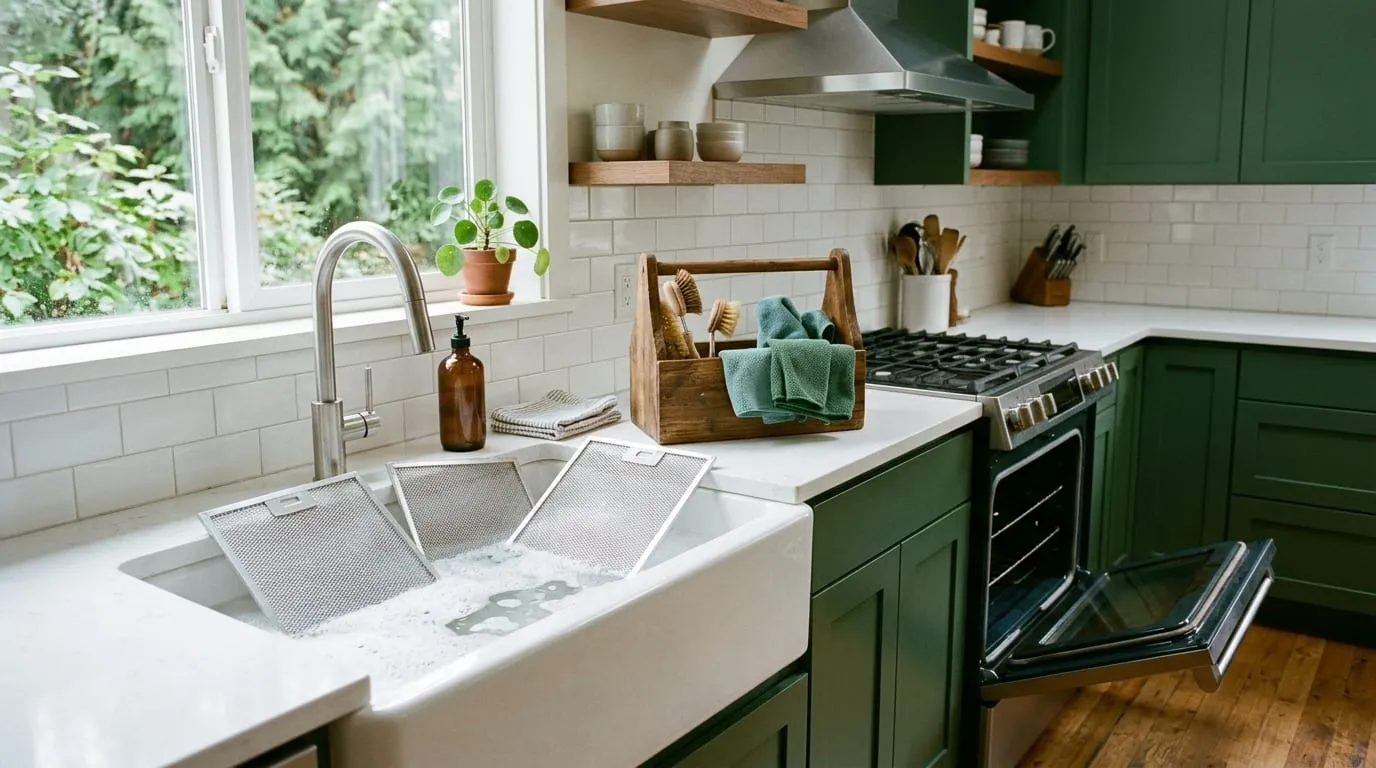
Whirlpool suggests soaking racks in soapy water, then scrubbing with a stiff-bristled brush. A bathtub lined with an old towel (to protect the finish) or a large utility sink fits full-size racks. Use hot water and a grease-cutting dish soap, soak for a few hours or overnight, scrub, rinse, and dry fully before sliding them back in. Use a non-scratch pad rather than steel wool if your racks are coated.
Door glass
- Inside glass: Whirlpool says light smudges come off with vinegar or glass cleaner. For thick buildup, apply baking soda paste, mist it with a 1:1 mix of vinegar or lemon juice and water, then wipe and gently scrape residual grease with a plastic scraper.
- Between the panes: Streaks between the two layers of glass mean taking the door off. Whirlpool notes this takes more time and a second person. Doors are heavy, so do it only by following your manual’s door-removal steps.
- Never use a metal scraper or steel wool on oven glass.
Knobs, control panel, and exterior
- Knobs: On many ranges the knobs pull straight off. Check the manual, make sure everything is off, photograph their positions, then wash them in warm soapy water and dry before replacing.
- Control panel and touchpads: Spray cleaner onto a cloth, never directly onto the panel, so liquid does not seep behind it. Some ovens have a control lock for cleaning; the manual explains it.
- Exterior: For stainless steel, Whirlpool suggests a stainless steel cleaner following product and appliance guidelines. It also advises wiping up acidic spills such as vinegar and tomato as soon as the range is cool to avoid damaging the finish.
What not to do
- Do not use commercial oven cleaner inside a self-cleaning oven.
- Do not leave racks, foil, pans, or a thermometer inside during self-clean unless the manual says they are safe.
- Do not scrub, soak, or spray the door gasket; it needs to seal.
- Do not line the oven floor with foil unless the manual allows it.
- Do not leave the house during a self-clean cycle, and do not try to force the locked door.
- Do not run self-clean with birds or other pets in or near the kitchen.
- Do not mix products, especially bleach with oven cleaner or vinegar.
- Do not use steel wool or metal scrapers on glass, enamel, or coated interiors.
How often to clean an oven
Whirlpool’s general guideline is a deep clean seasonally, or about every three months of regular use, with spills and splatters spot-treated in between. Real life varies: a weekly roaster needs it more often than an oven that mostly reheats leftovers. A good rule is to clean when you see a layer of buildup on the oven floor or it smokes when preheating. Wiping a spill once the oven has cooled, before the next bake, saves the most work. For how the oven fits with other deep-cleaning tasks, see how often to deep clean your home.
Worked example: a neglected oven before the holidays (illustrative)
The following is an illustrative scenario, not a real kitchen or a test.
Consider a Capitol Hill apartment with an electric range, a self-cleaning oven, and a year of baked-on drips from weekly sheet-pan dinners. A pet parakeet lives in the living room, which opens onto the kitchen.
- Decide. The manual confirms self-clean, says racks must come out, and says not to use commercial oven cleaner inside. Because of the bird and the open floor plan, they choose the paste method instead of self-clean.
- Night before. Racks go into a towel-lined bathtub with hot water and dish soap. The cool oven gets a double batch of baking soda paste, extra on the crusted floor, avoiding the gasket and elements.
- Next morning. After about 12 hours, they wipe the paste out with a damp cloth and a plastic scraper, rinse twice with clean water, and dry. The rack scrub takes 15 minutes.
- Door and controls. The inside glass gets a second paste-and-scrape pass; knobs come off for a wash in the sink.
In this scenario the paste method avoids hours of high heat near the bird and leaves the oven clean enough that a quick wipe after spills should keep it there. In a household without a bird, a self-clean cycle with the windows open would have been a reasonable choice too.
Moving out?
If you are cleaning the oven because you are leaving a rental, the standard is your move-in condition rather than your own comfort. Our sister site’s Seattle apartment move-out cleaning checklist covers what landlords typically check.
If an overnight oven project is more than you have time for, a deep clean is a reasonable thing to hand off. Sweepless in Seattle, which publishes this guide, offers deep cleaning in Seattle and several nearby cities; ask any cleaner which oven methods they use and whether they follow your manual.
Common questions
Can I leave the racks in during the self-clean cycle?
Only if your manual explicitly says your racks are self-clean safe. Whirlpool's instructions are to remove everything, racks included, because residue on them adds smoke and the high heat can damage them. Wash them in the sink instead.
Is it normal for the oven to smoke and smell during self-clean?
Some smoke and odor is normal as residue burns off, and Whirlpool says a heavily soiled oven makes more of it. Wipe out loose debris and big spills first, run the hood fan, open a window, and stay home. If smoke is heavy, follow your manual's steps for canceling the cycle; the door stays locked until the oven has cooled.
Why does my oven still look dirty after self-cleaning?
Usually the ash just needs wiping out with a damp cloth once the oven is completely cool. Whirlpool notes that heavily soiled ovens may need a longer cycle or a second cycle. Whirlpool also notes that even self-cleaning ovens need manual cleaning from time to time, especially the door glass.
How do I clean an oven with no self-clean or steam setting?
Use the baking soda paste method: coat the cool interior, let it sit, then wipe it off with water and a plastic scraper. If you prefer a commercial oven cleaner, check that your manual allows it for your oven's interior and follow the label exactly, with the kitchen ventilated.
Can I use oven cleaner on the outside of the oven or the cooktop?
Only where both the product label and your manual say it belongs. For the exterior, use warm soapy water or the cleaner your manual names for the exterior, and a cooktop cleaner approved by the manufacturer for a glass top.
Sources and references
- How does a self-cleaning oven work and how do you use it? , Whirlpool Primary source Accessed November 15, 2026
- Self-Clean vs. Steam-Clean Ovens: How to Choose , Whirlpool Primary source Accessed November 15, 2026
- How to Clean an Oven Inside and Out , Whirlpool Primary source Accessed November 15, 2026
- How to Clean Glass Oven Door Windows , Whirlpool Primary source Accessed November 15, 2026
- Dangers of Mixing Bleach with Cleaners , Washington State Department of Health Primary source Accessed November 15, 2026
- Volatile Organic Compounds' Impact on Indoor Air Quality , U.S. Environmental Protection Agency Primary source Accessed November 15, 2026
See something out of date or wrong? Tell the editors. Read how we work in our editorial policy.