How to Deep Clean a Kitchen, Step by Step
A step-by-step kitchen deep clean: the right order, oven, range hood filters, fridge, dishwasher filter, sink, disposal, cabinets, and a one-Saturday plan.
The short answer
Deep clean a kitchen from the top down and from the slow-soak jobs to the quick ones: start range hood filters and oven racks soaking, empty and clean the fridge, then work through the hood, cabinets, appliances, backsplash, counters, sink, and floor last. Plan on most of a day for an average kitchen, and follow each appliance's manual for the oven, filters, and dishwasher.
- Start anything that needs to soak (hood filters, oven racks, burner grates, fridge drawers) first, so it works while you do everything else.
- Use your oven's manual for self-cleaning. Never combine an oven cleaner with bleach; Washington's Department of Health says the two react.
- Keep the fridge at or below 40 degrees Fahrenheit and wipe spills promptly, as the FDA advises.
- Grease is the enemy in pipes too: Seattle Public Utilities says to let it cool and put it in compost or the garbage, never down the drain.
- Go top to bottom, and save counters, sink, and floor for last so nothing you knock down lands on a finished surface.
This guide is for anyone facing a kitchen that a weekly wipe-down no longer keeps up with: grease on the hood, a fridge with unknown jars in the back, an oven that smokes when you preheat it. The short version: start the slow jobs first, work top to bottom, and finish with counters, sink, and floor. Let soaking and dwell time do the hard work while you move around the room, and use each appliance’s manual for anything specific to that appliance.
Below you will find the order of operations, step-by-step methods for each zone, a printable checklist, and an illustrative one-Saturday plan.
Before you start: supplies and safety
A kitchen deep clean does not need a cabinet of special products. Most of it is hot water, a grease-cutting dish soap, and patience.
| Item | Used for | Note |
|---|---|---|
| Grease-cutting dish soap | Hood filters, cabinet fronts, grates, drawers | Your main degreaser for most jobs |
| A degreaser or oven cleaner your appliance manual allows | Baked-on oven grime, heavy hood grease | Follow the label and manual; ventilate |
| Baking soda | Mild scouring paste for stubborn spots | Non-scratch on most surfaces; test first |
| pH-neutral cleaner | Stone counters, sealed surfaces, general wiping | Safe default where you are unsure |
| Non-scratch scrub pads and a soft brush | Grates, sink, grout | Avoid steel wool on finishes |
| Old toothbrush and grout brush | Hinges, handles, backsplash grout | Reaches seams a cloth cannot |
| Microfiber cloths (several) | Wiping and drying | Keep a stack; swap when greasy |
| Plastic scraper | Cooktop drips, fridge shelf spills | Will not gouge most surfaces |
| A cooler with ice packs | Holding food while the fridge is empty | Keeps cold food cold during the clean |
| Gloves and a trash bag | Hands and the expired-food purge |
Two safety rules matter more than any product choice:
- Never mix products. The Washington State Department of Health (DOH) says bleach reacts with some oven cleaners, and with acids found in some automatic dishwasher detergents and rinses, drain cleaners, and vinegar. Use one product per surface, rinse between products, and keep bleach out of the oven entirely. Our guide to cleaners, sanitizers, and disinfectants has the full never-mix list.
- Ventilate. The EPA lists cleansers and disinfectants among household sources of volatile organic compounds and advises increasing ventilation when using them. Run the range hood fan and open a window, even on a wet November day.
The order of operations
Order is what turns a ten-hour slog into a manageable day. The principle is the same as any room (top to bottom, dry to wet), with one kitchen-specific twist: start the soaking jobs first.
- Clear the counters and take out trash and recycling.
- Start the soaks. Hood filters, burner grates, oven racks, and fridge drawers go into hot, soapy water (a sink, a tub, or a large bin).
- Start the oven if you are using a self-clean cycle and your manual allows it, or apply oven cleaner per its label so it can dwell.
- Empty the fridge into a cooler and clean it, so food is out of temperature range for as short a time as possible.
- Clean high: tops of cabinets, the range hood exterior, light fixtures.
- Cabinets and drawers, outside then inside.
- Small appliances and the microwave.
- Finish the oven, scrub the soaked parts, and reinstall hood filters.
- Dishwasher filter and interior.
- Backsplash and grout.
- Counters, then the sink and disposal.
- Floor last, working toward the doorway.
Step by step, zone by zone
Range hood and filters
Grease rises, so the hood is often the dirtiest surface in the kitchen.
- Check the hood’s manual for how the filters come out and whether they are dishwasher-safe. Recirculating hoods often have a charcoal filter that is replaced rather than washed.
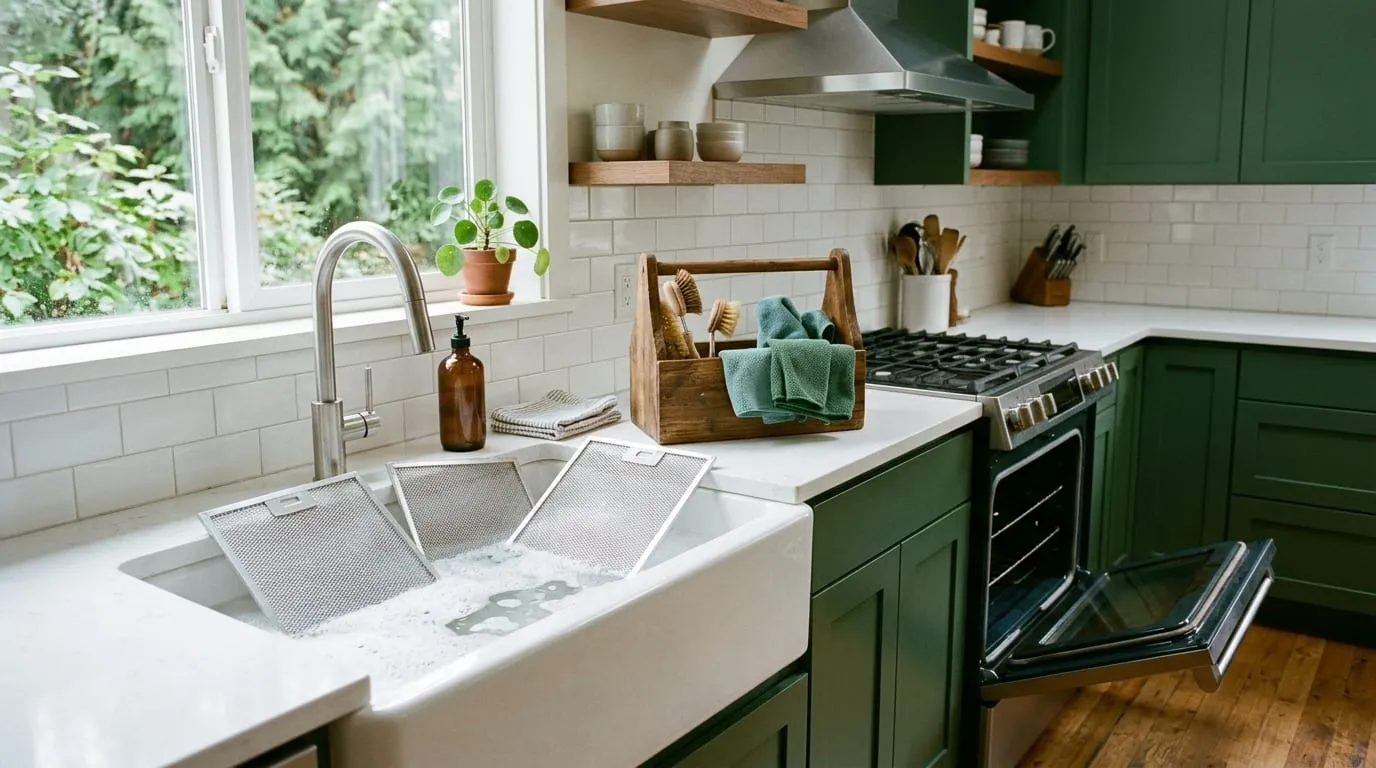
- Pop out the metal filters and submerge them in the hottest tap water you have with a generous squeeze of grease-cutting dish soap. A degreaser the manual allows can help with heavy buildup.
- Let them soak while you do other jobs, then scrub with a soft brush, working the mesh from both sides. Rinse with hot water and let them dry completely before reinstalling.
- Wipe the hood’s underside and exterior with warm soapy water and a cloth, then dry. On stainless steel, wipe with the grain.
A filter that still looks amber after one soak may need a second round; that is normal for a filter that has not been cleaned in a long time.
Oven
The manual is the authority here. Ovens differ in whether they have a self-clean or steam-clean cycle, what must be removed before running it, whether racks can stay in, what to avoid on the door gasket, and whether commercial oven cleaner is allowed on the interior.
If you use self-clean, read the manual’s section first, remove what it tells you to remove, and plan for the cycle and the cool-down lockout time it lists. Run the hood fan and open a window, since a dirty oven can smoke and smell as residue burns off. Stay home while it runs. Afterward, wipe out the ash with a damp cloth once the oven is cool.
If you clean by hand, scrape loose debris, apply the cleaner your manual permits (or a baking soda paste) and let it dwell per the label, then wipe and rinse thoroughly so no residue bakes on next time. Never use bleach in or near an oven where oven cleaner has been used; DOH lists oven cleaners among products that react with bleach.
Oven racks soaked in hot soapy water in step 2 usually need only a scrub with a non-scratch pad. Clean the glass inside the door last with a scraper and a damp cloth.
Cooktop and burner grates
- Gas grates and burner caps go into the soak. Scrub, rinse, and dry fully before replacing so the burners light cleanly.
- Smooth glass and ceramic tops: scrape cooled, cooked-on spills with a cooktop-safe scraper held at a low angle, then clean with a cooktop cleaner the manufacturer approves. Avoid abrasive pads that can scratch.
- Coil burners: follow the manual; most come out for cleaning of the drip pans underneath.
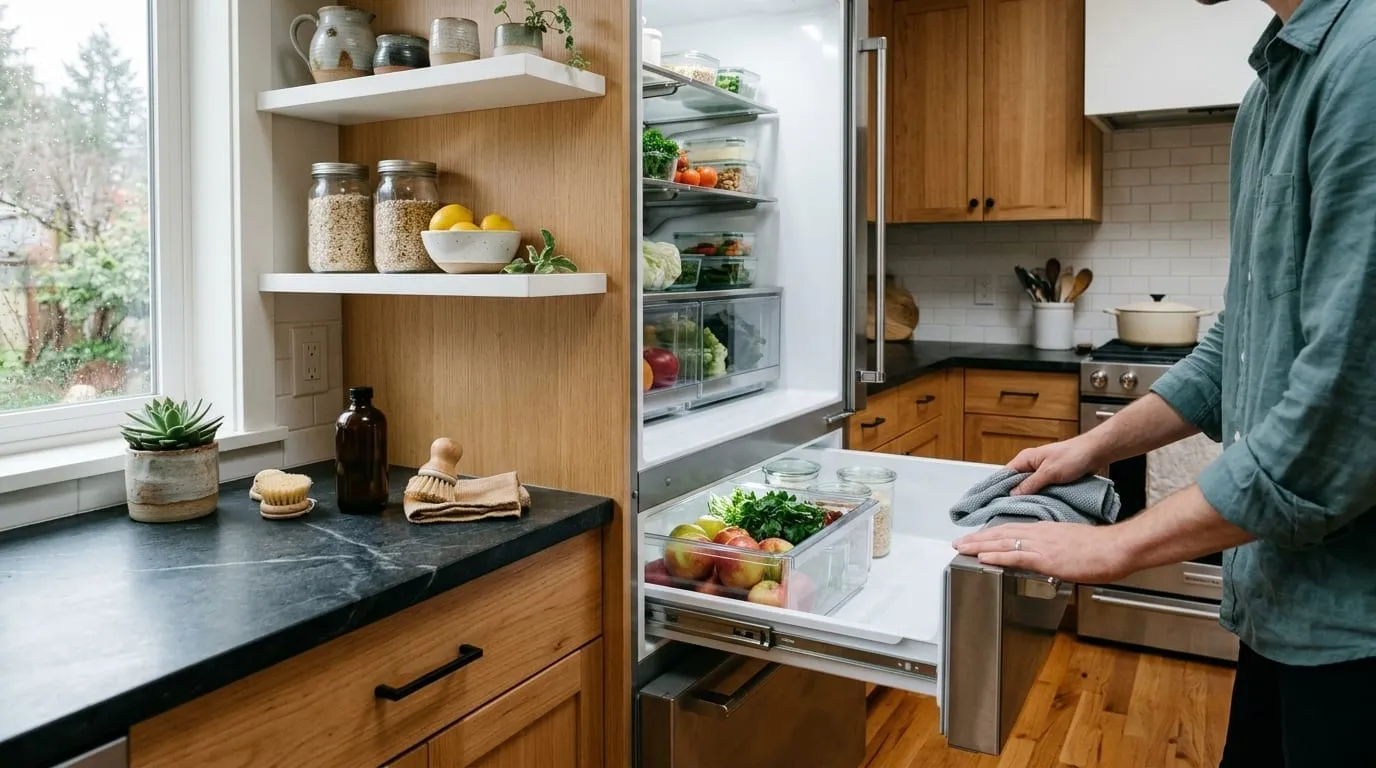
Refrigerator and freezer
The FDA recommends keeping the refrigerator at or below 40 degrees Fahrenheit and the freezer at 0 degrees, cleaning the refrigerator regularly, and wiping spills immediately to reduce the growth of Listeria bacteria. A deep clean is the moment to reset all three.
- Move food into a cooler with ice packs. Toss anything expired or doubtful.
- Remove shelves and drawers. Let cold glass shelves warm up on the counter before washing them in warm water.
- Wash shelves, drawers, and the interior walls with warm water and a little dish soap. Rinse with a clean damp cloth and dry.
- Clean the door gaskets with a cloth or toothbrush, getting into the folds where crumbs and mildew collect.
- Reassemble, put an appliance thermometer inside, and return food, wiping the bottoms of jars as you go.
- Check the manual for the condenser coils (behind or beneath the fridge): whether they need cleaning, how to reach them, and whether to unplug the fridge first.
Dishwasher
A dishwasher with a manual-clean filter needs that filter cleaned regularly, or food particles recirculate onto your dishes.
- Find the filter in the manual. On many models it sits under the bottom rack and twists out.
- Rinse it under warm running water and scrub gently with a soft brush and a little dish soap. Do not use a wire brush on mesh.
- Wipe the door edges and gasket, where drips dry into a sticky film, and clear any debris from the spray arms if the manual explains how.
- Reinstall the filter firmly, then run an empty cycle with any cleaner the manual recommends.
Dishwasher detergents and rinse aids can be acidic, per DOH, so do not run a bleach product through the same cycle.
Sink and garbage disposal
Clean the sink after the counters so you are not rinsing counter crumbs into a clean basin.
- Scrub the basin, drain, and faucet with dish soap and a non-scratch pad, then rinse and dry the faucet.
- For the disposal, InSinkErator’s instructions are to turn it off, remove the sink baffle (the rubber splash guard) and scrub its underside with a scouring pad, put it back, then run a medium stream of cold water with the disposal on. Odors, it notes, usually mean food has built up.
- InSinkErator says never to put fats, oils, or grease into a disposal and to avoid harsh cleaning products and non-food items.
That last point matters beyond the disposal. Seattle Public Utilities (SPU) says grease rinsed down the drain hardens and sticks to pipes, causing sewage backups, plumbing repairs, and pollution in Puget Sound. Its guidance: let grease cool, wipe small amounts up with a paper towel or newspaper and put it in the compost, and scrape large amounts into a lidded container for the garbage. During a deep clean, that includes the grease you scrape out of drip pans and the hood.
Cabinets and drawers
Cabinet fronts near the stove carry a film of airborne grease that dust sticks to.
- Dust the tops of upper cabinets first.
- Wipe fronts with warm water and grease-cutting dish soap, wrung out well, then dry. Too much water can swell painted MDF and wood edges.
- Use a toothbrush on handles, knobs, and hinges.
- Empty a few shelves at a time, vacuum crumbs, wipe, let dry, and put back only what you use. Shelf liners can come out and be washed or replaced.
Small appliances and microwave
- Microwave: heat a microwave-safe bowl of water for a few minutes, leave the door shut so steam softens splatters, then wipe. Wash the turntable separately.
- Toaster: unplug, empty the crumb tray, and wipe the outside. Never put utensils inside.
- Coffee maker and kettle: descale following the manufacturer’s instructions. In Seattle, water from the Seattle Public Utilities system is very low in hardness minerals (about 0.5 to 1.7 grains per gallon in SPU’s May 2026 analysis), so scale tends to build slowly; descale when you see it, not on a fixed schedule borrowed from hard-water advice.
- Stand mixer, blender, food processor: unplug, wipe housings, and clean around buttons with a cloth-wrapped toothbrush.
Backsplash, grout, and counters
Daltile, a large tile maker, says cleaners for ceramic tile need to be specified as safe for both the tile and the grout. Wash the backsplash with warm soapy water, scrub grout lines with a grout brush, and rinse well so no residue remains.
For counters, match the cleaner to the material. Daltile’s stone guidance says natural stone counters should be cleaned with pH-neutral cleaners made for stone and that stone cleaners should never contain acid or bleach. It warns that marble and limestone react even to mild acids like lemon juice, vinegar, and sliced tomatoes, leaving etched dull spots that cannot be removed without refinishing. Laminate, quartz, and solid-surface counters have their own maker guidance; when unsure, a neutral cleaner is the safe choice.
If raw meat touched a counter, clean it first and then use a sanitizer labeled for food-contact surfaces. The EPA notes that sanitizing kills bacteria and disinfecting kills bacteria and viruses; either way, follow the label for contact time and rinsing.
Floor
Vacuum or sweep first, paying attention to the gap beside the range and the toe kick under cabinets. Then damp-mop with the right product for your floor type, working toward the doorway. For wood, laminate, or vinyl kitchens, see how to clean hardwood and other floors in a wet climate.
Kitchen deep clean checklist
- Trash and recycling out, counters cleared
- Hood filters, grates, oven racks, and fridge drawers soaking
- Oven: self-clean started per manual, or cleaner applied per label
- Fridge emptied into a cooler, expired food discarded
- Fridge shelves, drawers, walls, and gaskets washed and dried; thermometer reads 40 degrees F or below
- Tops of cabinets, light fixtures, and hood exterior wiped
- Cabinet fronts, handles, and hinges degreased
- Cabinet and drawer interiors vacuumed and wiped
- Microwave, toaster, coffee maker, and other small appliances cleaned
- Oven interior, door glass, and racks finished
- Hood filters scrubbed, rinsed, dried, and reinstalled
- Cooktop and grates cleaned and dried
- Dishwasher filter cleaned, gasket wiped, empty cycle run
- Backsplash and grout scrubbed and rinsed
- Counters cleaned with the right product for the material
- Sink, faucet, and disposal baffle cleaned
- Collected grease wiped into compost or bagged for the garbage
- Floor vacuumed and mopped, including toe kicks
A worked example: one Saturday, one kitchen
Consider an illustrative scenario: a mid-size kitchen in a Wallingford house with painted cabinets, a gas range with a stainless hood, a quartz counter, a tile backsplash, and an oven with a self-clean cycle. One person is doing the deep clean, which has not happened in about a year. The time blocks below are rough editorial estimates for planning, not measurements; your kitchen may run faster or much slower.
| Time | Task | What is happening in the background |
|---|---|---|
| 8:00 to 8:30 | Clear counters, take out trash, read the oven and hood manuals | |
| 8:30 to 9:00 | Pull hood filters, grates, and racks into a soapy soak; start self-clean per the manual; open a window and run the fan | Soak and self-clean cycle begin |
| 9:00 to 10:30 | Empty fridge into a cooler, purge, wash shelves and drawers, clean gaskets, reload | Soak and oven continue |
| 10:30 to 11:00 | Dust cabinet tops, light fixture, and hood exterior | Oven still in cycle or cooling |
| 11:00 to 12:30 | Cabinet fronts, handles, then three or four cabinet interiors | |
| 12:30 to 1:00 | Lunch break | Oven cooling and unlocking |
| 1:00 to 1:45 | Scrub soaked filters, grates, and racks; dry; wipe out oven ash; clean door glass; reinstall | |
| 1:45 to 2:30 | Microwave, toaster, coffee maker, mixer | Filters finish drying |
| 2:30 to 3:00 | Dishwasher filter, gasket, start empty cycle | Dishwasher runs |
| 3:00 to 3:45 | Backsplash and grout | |
| 3:45 to 4:15 | Cooktop surface, counters, sink, disposal baffle | |
| 4:15 to 4:45 | Vacuum and mop the floor, toe kicks included; bag collected grease for the garbage |
Total: roughly eight hours with a break. The time-saving trick is visible in the right-hand column: the oven and the soaks work for hours while the person is somewhere else in the room. Skip the soak step and the scrubbing in the 1:00 block can easily double.
Moving out? Use a different standard
If you are deep cleaning because you are leaving a rental, the goal shifts from your own comfort to what a landlord inspects. Our sister site’s Seattle apartment move-out cleaning checklist covers the kitchen items that commonly come up at a move-out inspection.
Keeping it from getting this bad again
A few habits shrink the next deep clean considerably:
- Run the range hood whenever you cook, and wash the filters more often if you fry or sear regularly.
- Wipe the stovetop and the cabinet fronts nearest it once a week.
- Do a quick fridge purge before each grocery run.
- Clean the dishwasher filter on the schedule in your manual.
- Wipe up oven spills once the oven has cooled, before they bake on.
For how often each deeper task should happen, see how often to deep clean your home. For the weekly kitchen routine that sits between deep cleans, see the complete Seattle house cleaning guide. And if a whole Saturday is not realistic, our guide to professional cleaning versus DIY walks through when hiring help makes sense; Sweepless in Seattle, which publishes this guide, offers deep cleaning in Seattle and several nearby cities.
Common questions
How often should I deep clean my kitchen?
There is no single right interval. Many households do a full kitchen deep clean a few times a year and handle the hood filter, fridge wipe-down, and dishwasher filter more often. Heavy cooking, frying, pets, and kids all move tasks up the calendar; our deep cleaning frequency guide has a task-by-task table.
Should I use the self-clean cycle or clean the oven by hand?
Either can work, and your oven's manual is the deciding voice. It tells you whether self-clean is available, what to remove first, whether any cleaner can be used inside, and what to avoid on the door gasket. If the manual says not to use commercial oven cleaner on your model, do not.
Can I put range hood filters in the dishwasher?
Some metal mesh and baffle filters are dishwasher-safe and some are not, and charcoal (recirculating) filters usually cannot be washed at all. Check the hood's manual. When in doubt, hand-soak metal filters in hot water with a grease-cutting dish soap or a degreaser the manual allows.
What is the safest way to clean a granite or marble countertop?
Use a pH-neutral cleaner made for stone and dry the surface. Daltile notes that acids, even a light vinegar solution, can etch many natural stones, and that marble and limestone react even to lemon juice and tomatoes. Granite is generally tougher, but a neutral stone cleaner is the safe default for any stone.
Do I need to disinfect the whole kitchen?
No. Cleaning with soap or detergent removes dirt and most germs. Save sanitizers for food-contact surfaces after raw meat, and registered disinfectants for times when someone is sick, following the label's contact time.
Sources and references
- Are You Storing Food Safely? , U.S. Food and Drug Administration Primary source Accessed November 15, 2026
- Fats, Oils, and Grease (FOG) Clog Pipes , Seattle Public Utilities Primary source Accessed November 15, 2026
- Garbage Disposal FAQs , InSinkErator Primary source Accessed November 15, 2026
- What Can I Grind? , InSinkErator Primary source Accessed November 15, 2026
- Dangers of Mixing Bleach with Cleaners , Washington State Department of Health Primary source Accessed November 15, 2026
- What's the difference between products that disinfect, sanitize, and clean surfaces? , U.S. Environmental Protection Agency Primary source Accessed November 15, 2026
- Volatile Organic Compounds' Impact on Indoor Air Quality , U.S. Environmental Protection Agency Primary source Accessed November 15, 2026
- How to Care for and Maintain Natural Stone , Daltile Primary source Accessed November 15, 2026
- Ceramic and Porcelain Tile Care Instructions , Daltile Primary source Accessed November 15, 2026
- Quarterly Surface Water Analysis (samples collected May 19-20, 2026) , Seattle Public Utilities Primary source Accessed November 15, 2026
See something out of date or wrong? Tell the editors. Read how we work in our editorial policy.