Cleaning With Pets in a Wet Climate: Paws, Fur, and Floors
Everyday pet cleaning for a rainy climate: a paw-wiping station, shedding and HEPA vacuuming, enzyme cleaners for accidents, and floor-by-floor care.
The short answer
Stop water and grit at the door with a mat and a towel for every walk, vacuum carpet and fabric furniture at least weekly with a HEPA-filter vacuum (more often while your pet sheds), and treat urine accidents by blotting, rinsing with cool water, and using an enzymatic cleaner, never a steam cleaner. Match the wet-cleaning step to each floor type and keep pets off surfaces until cleaners have dried.
- A paw station at the door does more than any product: the Asthma and Allergy Foundation of America (AAFA) suggests wiping pets with towels or pet-friendly wipes after they have been outside.
- The EPA advises vacuuming carpets and furniture every week with a HEPA-filter vacuum; the Carpet and Rug Institute says to vacuum more often when you have pets.
- For urine, blot, rinse with cool water, then use an enzymatic cleaner. CRI and Humane World for Animals both warn that steam sets the stain and the smell.
- ASPCA Poison Control says most cleaning products are safe around dogs and cats when used per the label, but let enzyme cleaners dry before pets return, and keep dryer sheets and fabric softeners away from them.
- Trim nails and blot accidents fast on wood, laminate, and vinyl; Shaw lists pet nails as a scratch risk on hardwood and laminate.
This guide is for anyone sharing a home with a dog or cat in a place where it rains for much of the year. The short version: stop water and grit at the door with a towel for every walk, vacuum carpet and fabric furniture at least weekly with a HEPA-filter vacuum, and handle accidents with blotting, cool water, and an enzymatic cleaner rather than heat. Then match the wet step to each floor, and keep pets away from any surface until the cleaner on it has dried.
This guide covers everyday living with pets. If you are moving out of a rental with a pet, our sister site covers that in Moving Out of a Seattle Rental With Pets.
Why rain makes pet cleaning harder
Seattle averages about 39 inches of precipitation a year, with measurable rain on roughly 156 days, according to NOAA’s 1991-2020 normals for Sea-Tac. For a dog walked twice a day, that means many walks that end with wet paws and a dripping coat. Three things follow:
- Wet dirt travels farther. Dry dust falls off at the mat. Wet grit sticks to fur and pads and gets carried to the sofa.
- Wet fur holds allergens. AAFA explains that people with pet allergies react to proteins in dander, saliva, and urine, and that fur collects dander and can carry pollen and mold too.
- Damp textiles stay damp. Towels, beds, and rugs dry slowly in a closed-up house in winter. The EPA recommends keeping indoor humidity below 60 percent, ideally between 30 and 50, and drying wet materials within 24 to 48 hours to prevent mold growth.
Set up a paw station at the door
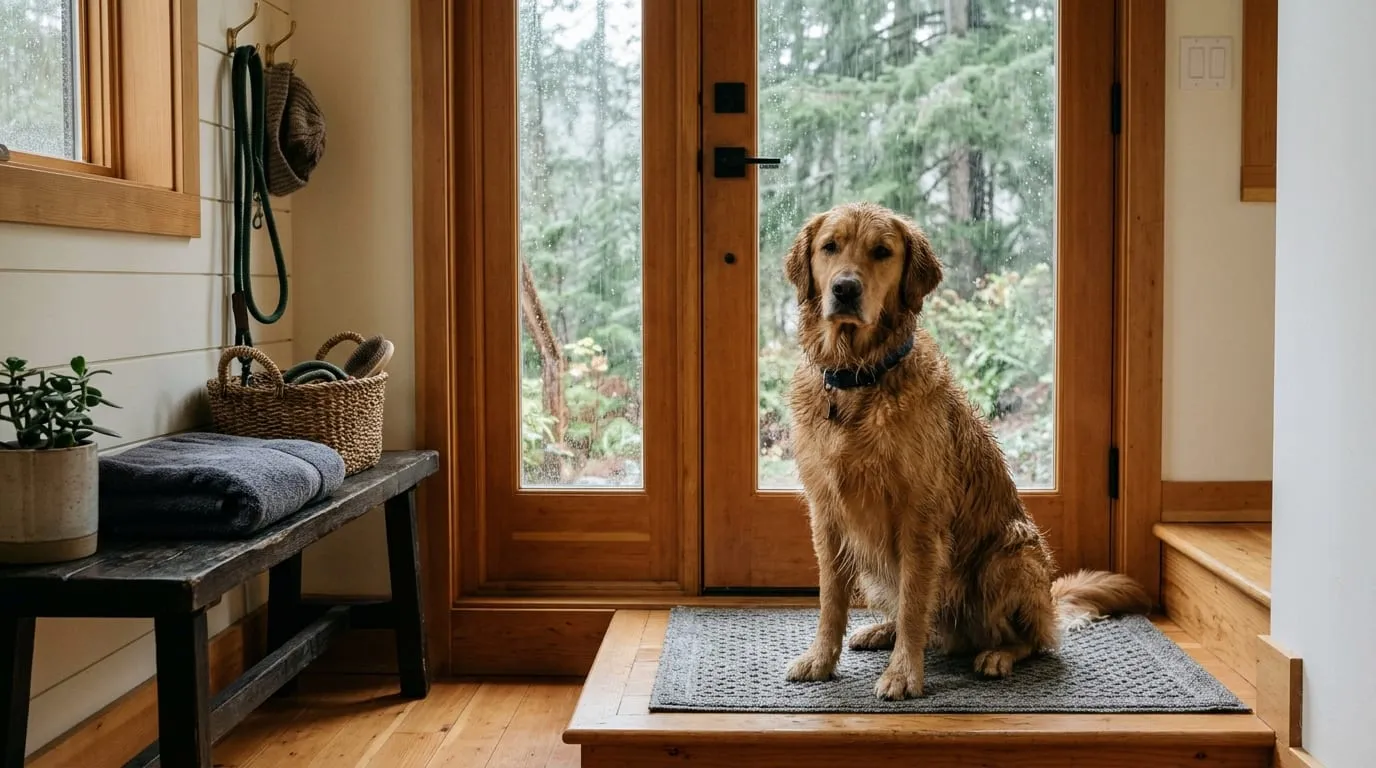
The single most useful pet-cleaning habit is stopping the dog before it leaves the entry. AAFA’s advice for allergy households is to wipe your pet down with pet-friendly wipes or towels after it has been outside, which removes pollen and urine as well as mud.
Paw station checklist
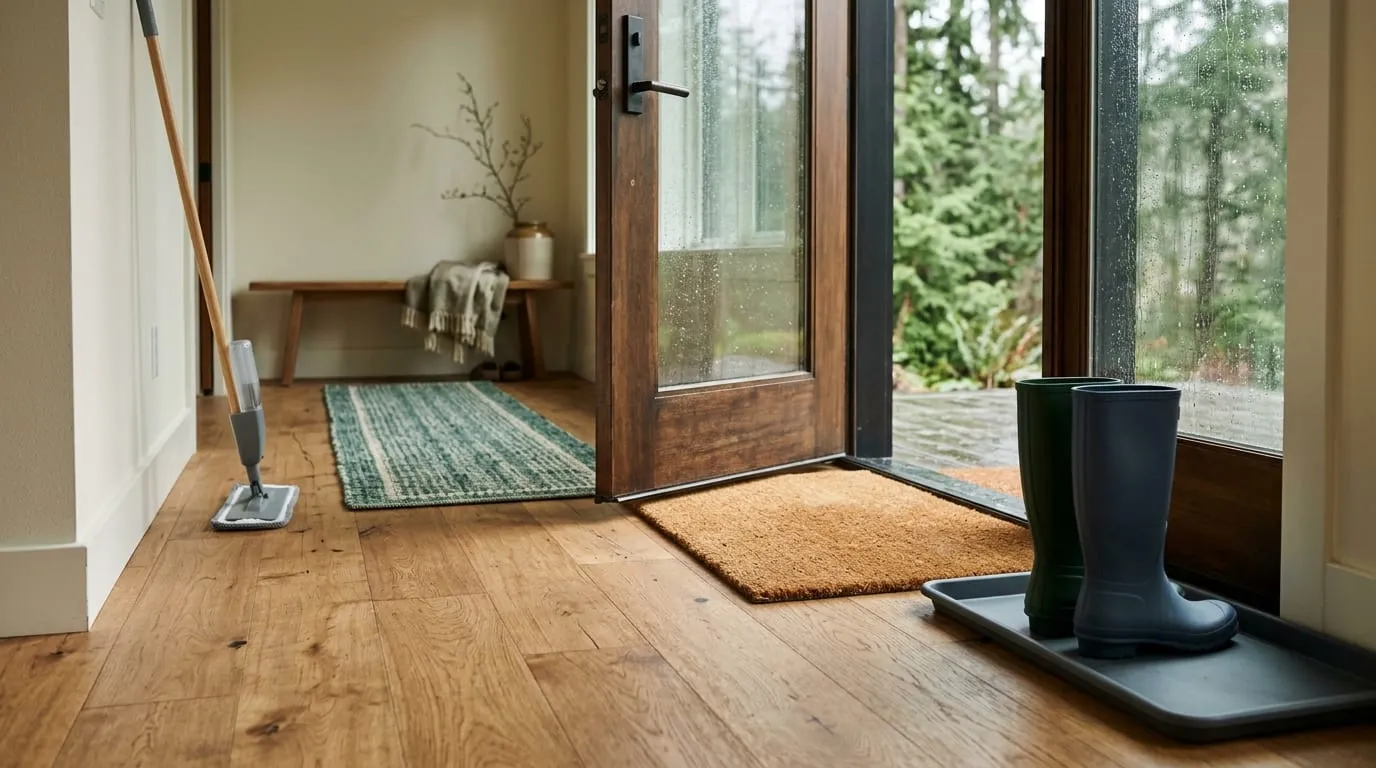
- Outdoor scraper mat big enough for the dog to stand on with all four feet while you open the door.
- Indoor absorbent mat at least as long as the dog, so the first few steps land on fabric, not floor.
- Two or three towels on hooks at your hand height, so one is always dry. Rotate them daily in the wettest months.
- A shallow tub or bin for very muddy days: a few inches of lukewarm water, dip one paw at a time, then towel.
- A leash hook and a boot tray, so drips from gear land in the tray.
The 60-second wipe, in order
- Stop the dog on the mat with a “wait” cue before unclipping the leash.
- Towel the underside and legs first; that is where the water and grit are.
- Wipe each paw, spreading the toes gently to reach between the pads.
- Towel the back and chest last, rubbing with the coat.
- Release the dog only once the paws are dry to the touch.
Wash paw towels hot every few days and hang them spread out, not folded, so they dry between walks. Our guide to keeping your home clean during Seattle’s rainy season covers the whole entry system and humidity control in more depth.
Control shedding and dander
AAFA notes that pet allergens are sticky, cling to walls, fabric furniture, and clothing, can stay at high levels for months, and get stirred back into the air by dusting and vacuuming. The goal is to remove them without throwing them around.
How often to vacuum
The EPA advises vacuuming carpets and furniture every week, using a vacuum with a HEPA filter on carpet and fabric-covered furniture. AAFA gives the same weekly rhythm for fabric furniture and carpets. The Carpet and Rug Institute (CRI) says to vacuum at least once a week and, specifically for homes with pets, to vacuum more frequently to capture hair and dander.
A practical reading of those three:
| Situation | Carpet and rugs | Fabric furniture | Hard floors |
|---|---|---|---|
| Short-coated pet, no allergies in the home | Weekly, plus traffic lanes midweek | Weekly | Two or three times a week |
| Heavy shedder or shedding season | Every other day in the pet’s main rooms | Twice a week | Every other day |
| Someone in the home has pet allergies or asthma | At least twice a week, HEPA vacuum, allergic person out of the room (EPA) | Twice a week, or keep pets off it (EPA, AAFA) | Every other day, then a damp microfiber wipe |
These frequencies are our editorial suggestions built on the EPA, AAFA, and CRI minimums, not figures from those organizations.
Vacuum so the dander stays in the bag
- Go slowly. CRI notes that a quick once-over does not do much.
- Empty canisters or replace bags when they are half to two-thirds full, as CRI suggests, and do it outdoors or straight into a bag.
- Follow with a damp or microfiber cloth on hard surfaces. AAFA says a damp cloth helps keep dander and fur from going back into the air.
Reduce what reaches the floor
AAFA suggests having someone without allergies brush the pet outdoors, and notes that washing your pet weekly may reduce airborne allergens. If anyone in the home has asthma, the EPA’s guidance is to keep pets out of that person’s bedroom and off furniture. Washable throws over the pet’s favorite seat make that easier when keeping them off is not realistic; AAFA recommends washing such covers weekly in hot water.
Accidents: enzyme cleaners, cool water, no steam
Urine is the stain that punishes the wrong method. Heat does not clean it; it fixes it.
Why heat and steam make it worse
CRI says not to use a steam cleaner on urine spots because the heat will set the stain and the smell; it advises extracting with a wet vacuum and rinsing with cool water instead. Humane World for Animals gives the same warning for carpet and upholstery, explaining that heat can permanently set the stain and odor by bonding the protein into man-made fibers. A steam mop on a hard floor spot raises the same concern, and Shaw tells hardwood owners not to use steam mops at all.
Fresh urine on carpet or a rug
- Blot hard. Humane World suggests a thick layer of paper towels topped with newspaper, then standing on it for about a minute and repeating until the area is barely damp. CRI says to use white, unprinted material so no dye transfers.
- Do not scrub. CRI warns that scrubbing and brushes can fray carpet and change its texture.
- Rinse with cool water and blot dry again. A small hand extractor or wet vacuum does this best, and CRI notes it is a good tool for quick pet cleanups.
- Apply an enzymatic cleaner made for pet odors, following its label for amount and dwell time. The ASPCA recommends an enzymatic cleanser designed to neutralize pet odors; Humane World describes enzymatic cleaners as breaking down pet waste odors.
- Let it dry fully, with the pet kept away. ASPCA Poison Control notes that most enzyme-based cleaners can cause mild stomach upset if licked, so the area should be dry before your pet returns.
Old or hidden spots
Humane World suggests using your nose, then a black light, to find dried spots you cannot see, outlining them lightly with chalk before you treat them. If urine has soaked into the carpet pad, surface cleaning may not reach it, and sections of carpet and pad may need replacing. CRI recommends calling a certified carpet cleaning firm for pet stains and odors you cannot remove.
Skip ammonia and vinegar on accident spots
Humane World advises against ammonia and vinegar for urine because strong chemical odors may encourage a pet to mark the same spot again. Never combine an accident cleaner with bleach or any other product; the Washington State Department of Health warns not to mix bleach with ammonia, acids, or other cleaners. Use one product, rinse, and let it dry. Our guide to cleaners, sanitizers, and disinfectants explains what each type does.
If accidents keep happening, Humane World and the ASPCA both suggest a veterinary check to rule out a medical cause.
Floor by floor with pets
Pets add nails, grit, and liquid. Confirm details with your floor maker’s care page, since warranties are written around those instructions.
| Floor | Nails and grit | Accidents and water | Avoid | Pet-specific tip |
|---|---|---|---|---|
| Hardwood (solid or engineered) | Shaw lists long pet nails as a don’t; the NWFA advises choosing a species that can handle nails and accidents | Wipe spills right away with a clean, dry cloth (Shaw); Humane World notes urine acid can react with varnish and discolor wood | Wet mops, steam mops, ammonia, harsh or abrasive cleaners (Shaw) | Rugs at the pet’s favorite turning and landing spots, with pads safe for wood |
| Laminate | Shaw’s weekly care list says to check pet nails and keep them trimmed | Blot at once; Shaw says not to wet mop laminate with soap, water, or any liquid cleaner | Steel wool, abrasive cleaners, strong ammonia or chlorine cleaners (Shaw) | Water bowls on a tray or mat, since the core swells if water reaches the seams |
| Luxury vinyl plank or tile | Use felt protectors under furniture (Shaw); sweep grit often | Blot with a clean white cloth, then a neutral pH cleaner (Shaw) | Abrasive, ammonia-based, and vinegar-based products (Shaw); latex- or rubber-backed mats | Choose entry mats without latex or rubber backing, as Shaw advises, to avoid discoloration |
| Ceramic or porcelain tile | Most resistant to nails; sweep or vacuum before mopping (Daltile) | Use a cleaner rated for tile and grout; grout absorbs what sits on it | Mopping with dirty water; leaving residue, which Daltile says can affect slip resistance | Rinse well after cleaning, since a slick floor is hard on older dogs |
| Carpet and rugs | Vacuum more often with pets (CRI) | Blot, cool-water rinse, enzymatic cleaner; no steam on urine (CRI) | Scrubbing, brushes, colored towels (CRI) | Professional deep cleaning every 12 to 18 months, or more often if needed (CRI) |
For finishes, cleaners, and the damp-mop method on each surface, see how to clean hardwood and other floors in a wet climate.
Pet-safe product cautions
ASPCA Poison Control states that most cleaning products are safe to use around dogs and cats as long as they are used according to the label. The cautions it does give are specific:
- Bleach. Swallowing undiluted bleach can injure the mouth and esophagus. Diluted bleach can be used on pet toys and kennels if it is thoroughly rinsed and the bleach odor is gone before the pet goes back.
- Vinegar and water. Vinegar is acidic and can cause stomach upset, but ASPCA says it is not generally an issue if diluted, rinsed, and allowed to dry.
- Enzyme cleaners. These can cause mild stomach upset; let them dry before pets enter the area.
- Laundry pods and liquid detergent. These can irritate the mouth and throat, and in some cases cause serious symptoms.
- Dryer sheets and fabric softeners. Most contain cationic detergents that can cause severe chemical burns if a pet chews or swallows them.
- Birds. ASPCA advises getting veterinary advice before using cleaning products around birds, which are extremely sensitive to fumes.
Follow the label, rinse where it says to, let surfaces dry, and store products out of reach. If you suspect an exposure, call your veterinarian or ASPCA Poison Control at (888) 426-4435.
Washing pet bedding, towels, and throws
Beds and blankets are where hair, dander, and damp collect. AAFA recommends washing slipcovers and blankets used on furniture weekly in hot water, and washing your pet’s favorite bedding and toys often. A workable routine:
- Shake or vacuum first, so the washer is not clogged with hair.
- Check the care label. Many pet beds have a removable cover and a foam insert that should not go in the washer.
- Wash hot if the label allows. For soiled items, Humane World suggests adding a one-pound box of baking soda to your regular detergent; if you can still see or smell the soiling, wash again with an enzymatic cleaner.
- Skip the softener. Given ASPCA’s warning about cationic detergents in dryer sheets and fabric softeners, leave them out of pet bedding loads and out of reach of chewers.
- Dry completely. In a damp climate, a bed that goes back slightly damp can turn musty within days. Use the dryer if the label permits, or dry it in a warm room with a fan.
- Keep a spare cover so the pet is never on a half-dry one.
Worked example: a townhouse with a dog and a cat
Consider an illustrative household: a Seattle townhouse with LVP on the main floor, carpet on the stairs and in two bedrooms, a tiled entry, and a fabric sofa. A shedding Labrador mix and an indoor cat live there, and one adult has a mild cat allergy. Times are rough estimates, not measurements.
- Every walk (2 minutes). The dog stops on the tiled entry’s mat, gets toweled from belly to paws, and is released dry. Towels hang on three hooks and are washed hot every third day.
- Daily in the wet season (10 minutes). The LVP gets a quick vacuum on the hard-floor setting in the kitchen and entry. The cat’s litter area is scooped, as the ASPCA recommends at least once a day.
- Twice a week (30 minutes). HEPA vacuuming of stairs, bedroom carpet, and the sofa, with the allergic adult out of the room as the EPA suggests. The washable throw on the sofa goes in a hot wash.
- Weekly (30 minutes). A damp mop on the LVP with the maker’s recommended cleaner; pet bed covers washed without softener.
- When an accident happens. The cat misses the box on the bedroom carpet. The household blots with white paper towels, rinses with cool water using a small hand extractor, applies an enzymatic cleaner per its label, and closes the door until the spot is dry. No steam, no vinegar.
- Every 12 to 18 months. A professional carpet cleaning for the stairs and bedrooms, as CRI recommends, sooner if accident spots build up.
The entry and the vacuum carry most of the load; accidents get a short, specific procedure.
When to bring in help
Some pet problems are past a home routine:
- An odor that returns after the spot dries, which can mean urine in the carpet pad. CRI recommends a certified carpet cleaning firm that knows pet stains and odors.
- Wood floors with dark, discolored spots where urine sat. Humane World notes the finish may have reacted and may need to be removed and replaced; that is a job for a flooring professional.
- Fabric furniture with set-in stains or a general smell. Check the cleaning code first; our guide on how to clean upholstery and fabric furniture explains what each code allows.
Our guide to how often to deep clean your home shows which tasks to move when pets are in the house.
Common questions
Is vinegar a good way to clean up after a pet accident?
It is not the best choice. Humane World for Animals advises against ammonia and vinegar on urine spots because a strong chemical smell may encourage a pet to mark the same place again. An enzymatic cleaner made for pet odors is the better tool, and vinegar is also on Shaw's avoid list for luxury vinyl.
How often should I wash my dog's bed?
No authority sets a single number, but weekly is a sensible baseline in shedding season or if anyone in the home has allergies, since AAFA recommends washing pet-used covers and throws weekly in hot water. Follow the bed's care label for temperature, and wash sooner after any accident or a muddy day.
Do I need a special vacuum for pet hair?
You need a vacuum that holds onto what it picks up. The EPA recommends a HEPA filter for carpet and fabric furniture, and AAFA points to vacuums certified as asthma and allergy friendly. Beyond that, a motorized upholstery tool and a crevice tool matter more than a pet label on the box.
Which cleaning products should I keep away from my pets?
ASPCA Poison Control flags undiluted bleach, laundry pods and liquid detergent, dryer sheets, and fabric softeners as risks if swallowed, and says birds are especially sensitive to cleaning fumes. Store products closed and up high, and if you think a pet has been exposed, call your veterinarian or ASPCA Poison Control at (888) 426-4435.
My cat keeps going in the same spot. Why does cleaning not stop it?
If any scent remains, the spot can keep drawing the cat back. The ASPCA recommends cleaning accidents thoroughly with an enzymatic cleanser designed to neutralize pet odors, and Humane World suggests a black light to find old spots you cannot see. Repeated accidents also warrant a vet visit to rule out a medical cause.
Sources and references
- Asthma Triggers: Gain Control , U.S. Environmental Protection Agency Primary source Accessed November 15, 2026
- Allergic to Your Pet? Learn About Dog and Cat Allergies , Asthma and Allergy Foundation of America Accessed November 15, 2026
- Control Indoor Allergens to Improve Indoor Air Quality , Asthma and Allergy Foundation of America Accessed November 15, 2026
- Cleaning and Maintenance (Carpet for Homes) , The Carpet and Rug Institute Accessed November 15, 2026
- How to Remove Pet Stains and Odors Naturally , Humane World for Animals Accessed November 15, 2026
- Poisonous Household Products , ASPCA Animal Poison Control Center Primary source Accessed November 15, 2026
- Litter Box Problems , ASPCA Accessed November 15, 2026
- Problem Prevention , National Wood Flooring Association Accessed November 15, 2026
- Hardwood Care and Maintenance , Shaw Floors Primary source Accessed November 15, 2026
- Laminate Care and Maintenance , Shaw Floors Primary source Accessed November 15, 2026
- Luxury Vinyl Care , Shaw Floors Primary source Accessed November 15, 2026
- Ceramic and Porcelain Tile Care Instructions , Daltile Primary source Accessed November 15, 2026
- Dangers of Mixing Bleach with Cleaners , Washington State Department of Health Primary source Accessed November 15, 2026
- A Brief Guide to Mold, Moisture and Your Home , U.S. Environmental Protection Agency Primary source Accessed November 15, 2026
- 1991-2020 Annual Normals, Seattle-Tacoma International Airport (USW00024233) , NOAA National Centers for Environmental Information Primary source Accessed November 15, 2026
See something out of date or wrong? Tell the editors. Read how we work in our editorial policy.