How to Prevent and Remove Mildew on Window Sills and Frames
Why Seattle windows sweat in winter, how to clean mildew off wood, vinyl, aluminum tracks, and caulk, when to recaulk, and a daily routine that stops it coming back.
The short answer
Scrub small mildew spots off sills and frames with detergent and water, dry them completely, and replace any caulk that stays stained after cleaning. Then stop the cause: wipe condensation off glass and sills every morning in the cold months and keep indoor humidity below 60 percent, ideally 30 to 50 percent, as the EPA recommends.
- Windows sweat when the glass is colder than the dew point of the indoor air. Warm, damp air from showers, cooking, breathing, and drying laundry meets cold glass, and the water lands on the sill.
- Most black spots on sills are a surface problem: scrub with detergent and water, dry thoroughly, and clean by material so you do not damage paint, vinyl, or seals.
- Mildew that has grown into caulk or silicone rarely scrubs out. Cut the old bead out, clean and dry the joint, and recaulk; never caulk or paint over mold.
- The EPA says patches under about 10 square feet are usually a DIY job. Larger growth, soft or rotting wood, or mold that keeps returning needs a professional or, for renters, the landlord.
- In a home built before 1978, treat chipped or peeling sill paint as a possible lead hazard: wet-wipe, never sand or scrape it dry, and check EPA's lead-safe guidance first.
Black spots on a Seattle window sill are a water problem first and a cleaning problem second. Small spots come off with detergent, water, and a soft brush, as long as you dry the surface completely afterward. Caulk that stays stained after a good scrub needs replacing, not more scrubbing. And the only lasting fix is stopping the nightly condensation that feeds it. This guide explains why windows sweat, how to clean each sill and frame material without damaging it, when to call in help, and a five-minute morning routine that keeps mildew from coming back.
Why Seattle windows sweat in winter
Condensation is simple physics. Air always holds some water vapor. The National Weather Service defines the dew point as the temperature the air must be cooled to before it reaches 100 percent relative humidity; cool it further and the water has to come out as liquid. Outdoors, that makes fog and dew. Indoors, it makes wet windows.
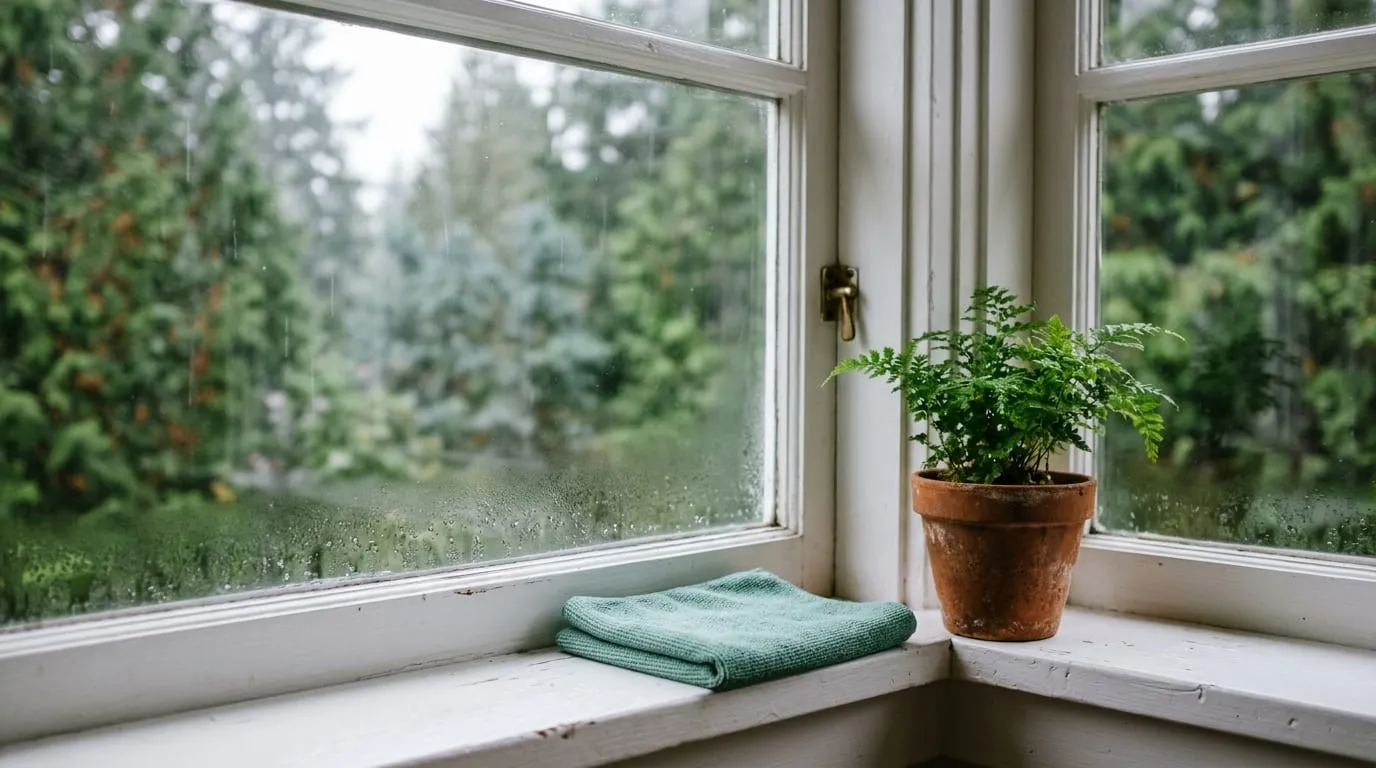
In winter, the coldest surface in most rooms is the window glass, and the frame and sill right below it. When the glass is colder than the dew point of the room air, water forms on it, runs down, and pools on the sill and in the tracks. The damper the indoor air, the higher its dew point, and the sooner the glass starts to drip.
What makes it worse in a Seattle home
- Long, wet, cool winters. NOAA’s 1991-2020 normals for Sea-Tac show November (6.31 inches), January (5.78), and December (5.72) as the wettest months. Windows stay shut, so indoor moisture has nowhere to go.
- Indoor moisture sources. Showers, cooking, breathing, houseplants, and laundry dried on racks all add water to the air. The EPA lists venting dryers and stoves outdoors, running the bathroom fan, and using exhaust fans while cooking as ways to bring humidity down.
- Cold glass and frames. Single-pane glass and older metal frames run colder than modern insulated units, so they reach the dew point sooner.
- Still air. Heavy curtains and closed blinds trap a pocket of air against the glass that cools down overnight.
The EPA puts the warning plainly: condensation can be a sign of high humidity. If your windows run with water most mornings, the room’s humidity, not the window, is usually the thing to fix.
Before you start: safety checks
These decide whether this is a cleaning job at all.
Is it small enough to do yourself?
The EPA says that if the moldy area is less than about 10 square feet, roughly a 3 by 3 foot patch, you can in most cases handle the job yourself. A window sill and frame is usually well under that. Stop and get help instead if:
- Growth covers more than about 10 square feet, or extends onto the wall below the window.
- There has been a real leak or water damage, not just condensation.
- The wood is soft, spongy, or crumbling when you press it with a fingernail or a screwdriver tip.
- Mildew returns within days of a thorough cleaning.
Is the paint possibly lead-based?
If your home was built before 1978, the EPA says it is more likely to have lead-based paint, and it singles out surfaces that rub, such as window sills, as places where worn paint makes hazardous chips and dust. For cleaning, that changes three things:
- Wet-clean only. The EPA advises wiping sills with a damp sponge, cloth, or paper towel, and not using steel wool, scouring pads, or abrasive cleaners.
- Do not scrub too hard. The EPA also says not to rub excessively at spots or stains.
- No dry sanding or scraping. Pick up any loose chips with a damp paper towel, bag them, and wipe the surface again.
Repainting or replacing old sills is a renovation, not a cleaning. EPA’s renovation, repair, and painting rule requires firms that disturb paint in pre-1978 homes to be lead-safe certified; renters should leave that work to the landlord, who must follow the rule too.
Protective gear
For mildew cleanup with detergent and water, the EPA says ordinary household rubber gloves are fine, and recommends goggles and avoiding touching mold with bare hands. It suggests an N-95 respirator to limit what you breathe. Open the window or run a fan while you work.
How to clean mildew off a window sill, step by step
This is the general method. The next section adjusts it by material.
- Dry and inspect. Wipe away standing water and look for soft wood, peeling paint, or cracked caulk.
- Vacuum loose debris from the sill and track with a crevice tool. This keeps you from smearing grit into a muddy paste.
- Wash with detergent and water. The EPA’s instruction for hard surfaces is to scrub mold off with detergent and water. A few drops of dish soap in warm water, a soft brush or old toothbrush for corners, and a cloth for flat areas is enough for most sills.
- Rinse with a cloth wrung out in clean water.
- Dry completely. Use a dry towel, then leave the window uncovered with air moving across it. The Washington State Department of Health stresses keeping the home dry as the way to control mold.
- Check in a week. If the spots come back, the moisture source is winning, or the mildew is inside the caulk.
About bleach and mildew removers
The EPA does not recommend chlorine bleach or other biocides as a routine part of mold cleanup, and points out that a background level of spores always remains anyway. If you decide to use a labeled mildew remover on a stubborn stain, use one product at a time, ventilate, test on a hidden spot, and follow the label for dwell time. The Washington State Department of Health warns never to mix bleach with ammonia, acids, or other cleaners; vinegar is an acid, and some glass cleaners contain ammonia. Our guide to cleaners, sanitizers, and disinfectants covers why.
Cleaning by sill and frame material
| Material | What usually grows mildew | Clean with | Avoid | Replace or repair when |
|---|---|---|---|---|
| Painted wood | Corners where sill meets sash, cracks in paint, end grain | Mild detergent, soft cloth or brush, quick dry | Soaking, abrasive pads, hard scraping; dry sanding on pre-1978 paint | Wood is soft, paint is peeling to bare wood, or stain sits under the paint |
| Vinyl | Sill surface film, weep slots, corners of the track | Mild detergent, soft brush, cloth | Abrasive powders and scouring pads that dull the surface | Frame is cracked or the sash no longer seals |
| Aluminum frames and tracks | Track channels where dirt and condensation sit | Vacuum, then detergent with an old toothbrush or a cloth over a flat tool | Steel wool, which can scratch | Tracks are corroded or water stays trapped because weep holes are blocked |
| Caulk and silicone beads | Into the bead itself, along edges that have pulled away | Detergent and a soft brush on the surface | Picking at the bead, which opens gaps | Stains remain after cleaning, or the bead is cracked, shrunk, or loose |
| Window glass | Edges, along the bottom of the pane | Detergent or glass cleaner, squeegee | Mixing glass cleaner with bleach products | Fog or droplets inside a double pane, which means a failed seal |
Painted wood sills
Painted wood is the most common sill in older Seattle houses and the most vulnerable. Water that gets through cracked paint soaks into the wood, and mildew follows. Wipe gently, use as little water as gets the job done, and dry straight away. Watch the lower corners of the sash and the joint where the sill meets the side casing. If the spots sit under the paint film, cleaning the surface will not reach them; that is a repainting job for later, done lead-safe if the home is pre-1978.
Vinyl sills and frames
Vinyl does not absorb water, so mildew on vinyl is usually growing in a film of dust and condensation on top. Detergent and a soft brush remove it. Clear the small weep slots along the bottom of the frame with a pipe cleaner or a cotton swab so water drains outside rather than sitting in the track. Check your window maker’s care guide before using any solvent.
Aluminum tracks
Sliding window tracks collect grit, insects, and water. Vacuum first with a crevice tool. Then wrap a damp, soapy cloth over a flat tool such as a putty knife or a chopstick and run it along the channel. Finish with a dry cloth the same way. If water still sits in the track after a cleaning, the drain holes may be blocked.
Caulk and silicone
Caulk is the material most likely to defeat you. Mildew can grow into the bead and stain it from inside, especially where the bead has pulled away from the frame and water sits in the gap. Clean the surface once with detergent and a soft brush and let it dry. If the dark color is still there, stop scrubbing. That bead needs replacing.
When caulk must be replaced, not cleaned
Replace a window caulk bead when any of these is true:
- It stays stained after a proper cleaning and full drying.
- It has cracked, shrunk, or pulled away from either surface.
- It feels hard and brittle, or gummy and soft.
- Water gets behind it, or the frame behind it is wet after rain.
How to do it right:
- Cut out the old bead with a utility knife or caulk removal tool. Do not cut into old painted wood in a pre-1978 home without following lead-safe practices.
- Clean and dry the joint. Sealant makers require this; for example, DAP’s instructions for its window and door sealant say the surface should be clean and free of old sealant, dirt, and other contamination.
- Do not seal over mold. Both the EPA and the Washington State Department of Health say not to paint or caulk over mold; clean it and dry the surface first.
- Choose the right product for the location (interior or exterior, the materials on each side) and follow its label for temperature range and cure time.
- Keep the new bead dry for the curing time on the label, which may mean pausing the morning wipe on that window.
Prevention: the routine that keeps sills clean
Cleaning without prevention means repeating the job every week.
Keep indoor humidity in range
The EPA recommends keeping indoor humidity below 60 percent if possible, ideally between 30 and 50 percent. A small digital hygrometer shows you where you are. If the reading sits above 60 percent in winter, the windows will keep sweating no matter how often you wipe them. Our rainy season cleaning guide explains how to read the meter and size a dehumidifier.
Ventilate the moisture at its source
- Run the bathroom fan during every shower and for a while after. Our guide to cleaning a bathroom exhaust fan covers how to keep it pulling air.
- Use the range hood whenever you cook.
- Dry laundry in a dryer vented outdoors, not on racks in a bedroom.
- Open a window briefly while cooking or showering when practical; the EPA lists increasing ventilation among the actions that help prevent condensation.
Help air reach the glass
- Open blinds and curtains during the day, and leave a gap at night in the worst rooms.
- Move furniture a few inches away from exterior walls, as the Washington State Department of Health advises.
The morning wipe-down checklist
Keep a squeegee and two absorbent cloths near the worst windows from about November to March.
- Squeegee or wipe the glass from top to bottom
- Wipe the sill dry, including corners
- Wipe any water from the track or the bottom rail of the sash
- Open the blinds so air moves over the glass
- Hang the cloths to dry, and wash them every few days
- Glance at the hygrometer; note anything over 60 percent
The Washington State Department of Health’s advice matches this exactly: check around windows for condensation and water droplets and wipe them up right away so mold cannot start to grow.
A seasonal schedule
| When | Task |
|---|---|
| October | Vacuum and wash all tracks; clear weep holes; check caulk and paint; buy or test a hygrometer |
| November to March | Morning wipe on sweating windows; weekly detergent wipe of sills; wash wipe cloths |
| January | Inspect worst windows for returning spots and soft wood; note any caulk to replace |
| April to May | Deep clean frames and tracks; replace failed caulk in dry weather; wash curtains |
| Summer | Exterior repairs and repainting, done lead-safe in pre-1978 homes |
For how window work fits into a broader schedule, see how often to deep clean.
Worked example: a north-facing bedroom (illustrative)
The following is an illustrative scenario, not a measurement or a real household.
Consider a 1950s house with original painted wood windows. In the north-facing bedroom, two adults sleep with the door closed and the blinds down. By January, the lower glass is streaming every morning, and black specks have appeared on the sill corners and along the caulk where the sill meets the wall.
- Check first. The paint is intact except one small chipped corner. Because the house is pre-1978, they wet-wipe that corner, bag the chips, and do not sand. The wood under the corner is firm.
- Measure. A hygrometer reads in the mid 60s first thing in the morning, above the EPA’s 60 percent ceiling.
- Clean. Detergent and water with a soft brush take the specks off the painted sill. The caulk bead stays gray after it dries, so it goes on the list to cut out and replace in spring.
- Fix the source. They stop drying laundry on a rack in the room, leave the door ajar at night, raise the blinds by a few inches, and run the bathroom fan longer after morning showers.
- Routine. A two-minute squeegee and sill wipe each morning.
In this scenario, the reading drifts into the 50s over the following weeks, the morning water shrinks to a thin band at the bottom of the glass, and the sill stays clean. The caulk is replaced on a dry day in April.
When to call a professional
Call in help, rather than cleaning harder, when:
- Mold is larger than about 10 square feet or follows significant water damage. For these cases the EPA refers readers to its more detailed guide, Mold Remediation in Schools and Commercial Buildings.
- The wood is rotting. That is a carpentry or window repair job.
- There is fog between double panes. The insulated glass seal has failed; a window company can replace the glass unit.
- Paint is peeling in a pre-1978 home. Use an EPA lead-safe certified contractor for any repair that disturbs it.
- You rent. Report leaks, rot, and recurring mold to your landlord in writing.
A house cleaner can handle the routine part well: tracks, sills, frames, and glass, plus surface mildew, as part of a regular or seasonal deep clean. Structural repairs, remediation, and lead-safe paint work are not cleaning jobs and need the right trade.
Common questions
Is the black stuff on my window sill mold or just dirt?
You often cannot tell by looking, and for cleaning purposes it does not matter much. Black specks that come back in the same damp corner, smell musty, or sit under a bead of caulk are usually mildew. Treat it the same way either way: detergent, water, a soft brush, and a thorough dry.
Should I use bleach on mildewed window frames?
It is not the first step. The EPA does not recommend biocides such as chlorine bleach as a routine part of mold cleanup and advises scrubbing hard surfaces with detergent and water. If you choose a labeled mildew remover, use it alone, ventilate, test it on a hidden spot, and follow the label. Never combine bleach with ammonia, vinegar, or other cleaners.
Will a dehumidifier stop my windows from sweating?
It can help a lot in a damp room, because lowering indoor humidity lowers the dew point of the air, so the glass has to be colder before water forms. It works best alongside bathroom and kitchen exhaust fans and the daily wipe. A hygrometer tells you whether you need one.
I rent. Whose job is a mildewed sill?
Wiping condensation and cleaning small surface spots is routine housekeeping. Leaks, rotting wood, failed window seals, peeling paint in an older building, and mold that returns despite cleaning are building problems: report them to your landlord or manager in writing, as the EPA advises renters to do for moisture problems.
Sources and references
- A Brief Guide to Mold, Moisture and Your Home , U.S. Environmental Protection Agency Primary source Accessed November 15, 2026
- Mold Cleanup in Your Home , U.S. Environmental Protection Agency Primary source Accessed November 15, 2026
- Mold , Washington State Department of Health Primary source Accessed November 15, 2026
- Dangers of Mixing Bleach with Cleaners , Washington State Department of Health Primary source Accessed November 15, 2026
- Reduce the Risk of Lead Exposure at Home , U.S. Environmental Protection Agency Primary source Accessed November 15, 2026
- Lead Renovation, Repair and Painting Program Rules , U.S. Environmental Protection Agency Primary source Accessed November 15, 2026
- Dew Point vs. Humidity , National Weather Service (NOAA) Primary source Accessed November 15, 2026
- Monthly Climate Normals 1991-2020, Seattle-Tacoma International Airport (USW00024233) , NOAA National Centers for Environmental Information Primary source Accessed November 15, 2026
- DAP Dynaflex 800 Window, Door and Siding Sealant: How to Use , DAP Accessed November 15, 2026
See something out of date or wrong? Tell the editors. Read how we work in our editorial policy.