How to Clean Up After Wildfire Smoke Indoors
When to start, what to wear, and how to clear smoke dust and ash from surfaces, floors, fabrics, and HVAC filters once the air clears, plus a prep checklist.
The short answer
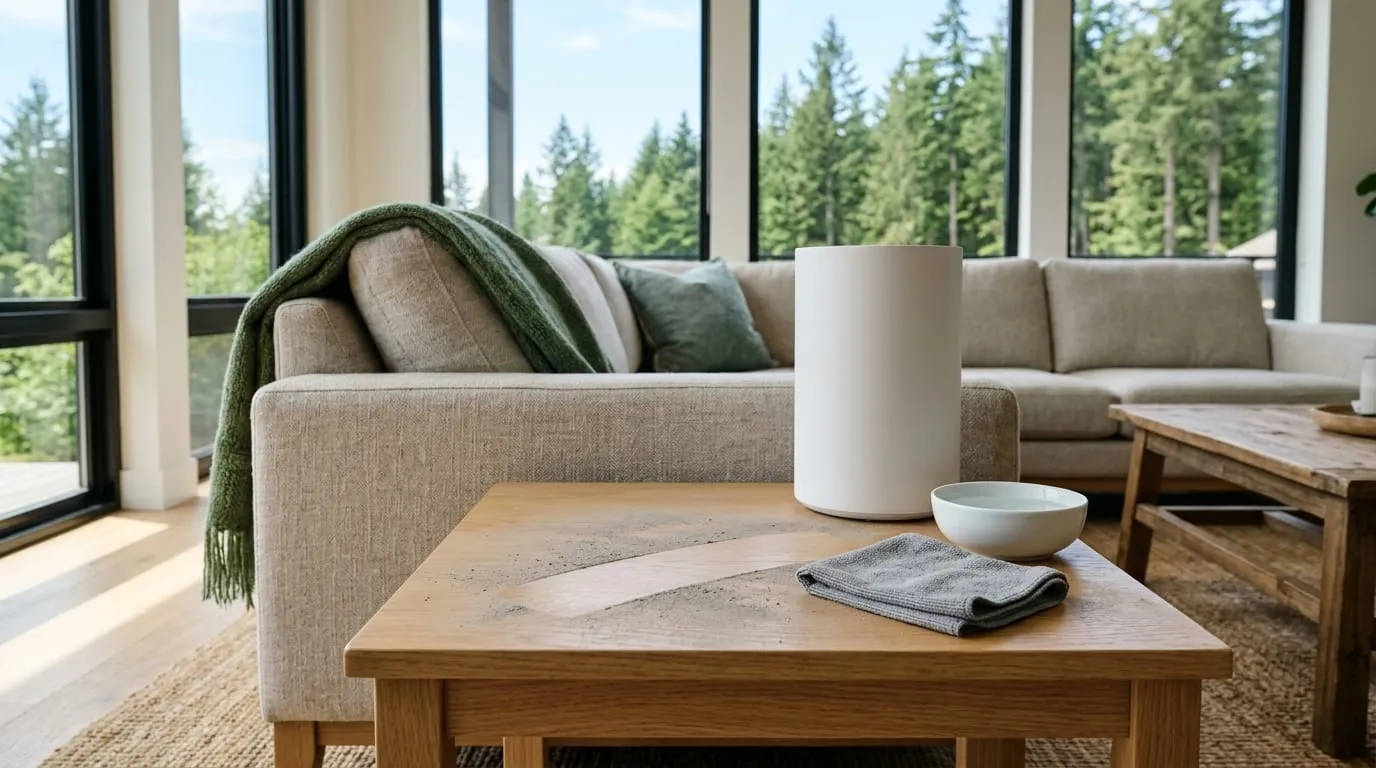
Wait until outdoor air quality has improved, then clean with damp methods: wipe hard surfaces and walls with a cloth and mild detergent, vacuum carpets and upholstery with a HEPA vacuum, mop hard floors instead of sweeping, and wash curtains, bedding, and clothes. Replace your HVAC filter with a MERV 13 or the highest rating your system can take, and run a HEPA air cleaner while you work and after.
- Start after the smoke has cleared outside. Washington's Department of Health says not to open windows until outdoor air quality has improved, and to keep them shut on windy days when ash can blow in from elsewhere.
- Never dry dust or sweep ash. The EPA and Washington's Department of Health both say to damp wipe, wet mop, and use a HEPA vacuum so fine particles are captured instead of thrown back into the air.
- Wear a NIOSH-approved N95 or P100 respirator with two straps, gloves, and long sleeves. Children, older adults, pregnant people, and anyone with heart or lung disease should stay out of the cleanup.
- Swap the HVAC filter for a MERV 13 or the best your system can handle, check it often, and replace it monthly until the smoke smell is gone, as Washington's Department of Health advises after a fire.
- Heavy ash, ash from burned buildings, or any chance of asbestos is a job for a fire restoration professional. Call your insurer before you clean or throw anything away.
Clean up after wildfire smoke once the air outside has improved, and do it wet, not dry. Wipe hard surfaces and walls with a damp cloth and mild detergent, mop hard floors, vacuum carpets and upholstery with a HEPA vacuum, launder fabrics, and put a fresh high-efficiency filter in your furnace or air handler. Wear a two-strap N95 or P100 respirator while you work, keep children and anyone with heart or lung disease out of it, and leave heavy ash or ash from burned buildings to a professional. This guide walks through each step in order, with a surface-by-surface table and a checklist for getting ready before next season.
Why smoke cleanup matters in a Seattle home
Smoke that reaches Seattle usually comes from distant fires, so the main problem is the air rather than a layer of ash. Washington’s Department of Ecology calls wildfire smoke the largest source of particle pollution in the state, and the EPA says its biggest health threat is fine particles, indoors as well as out.
Outdoor air gets in through open windows, exhaust fans, HVAC fresh air intakes, and small gaps around windows and doors, according to the EPA. After several smoky days, that can leave fine dust on sills, a smell in fabrics, and a dirty furnace filter.
Washington’s Department of Health notes that smoke season typically starts in July or August but can begin as early as May, so this is usually a late summer or early fall job.
Step 1: Wait for good air, then decide how big the job is
When to start
Do not start while smoke is still thick outside. Washington’s Department of Health says not to open windows until outdoor cleanup has finished and outdoor air quality has improved, and to keep windows closed on windy days because ash from other areas can blow in. Check current conditions on the AirNow Fire and Smoke Map or Ecology’s Washington air quality map before you start.
The EPA’s advice is to take advantage of times when air quality improves, even briefly, to open windows and air out the house, and to run the kitchen and bathroom exhaust fans while you do.
Light film or heavy ash?
Washington’s Department of Health draws a useful line:
- Surfaces mostly visible, with a small amount of ash or dust: you can usually clean it yourself with the steps below.
- Surfaces mostly covered by ash: take extra precautions and consider hiring a professional contractor to clean indoors.
Ash from burned buildings also moves a job out of DIY territory: the Department of Health warns it is more toxic than vegetation ash and can contain heavy metals and asbestos. Homes built before 1980 are at higher risk of containing asbestos, so if your own home was damaged by fire, have a qualified contractor test before you disturb debris.
Step 2: Protect yourself and your household
Who should not help
The EPA says children, older adults, and people with heart or lung diseases such as asthma should not take part in cleanup work. Washington’s Department of Health adds pregnant people and anyone over 65, and asks that infants, children, and pets be kept away from ash during cleanup.
What to wear
- A NIOSH-approved N95 or P100 respirator with two straps. The EPA says to look for “NIOSH” and either “N95” or “P100” printed on it, and to choose a size that seals over your nose and under your chin. Surgical masks and one-strap dust masks will not protect your lungs.
- A real seal. The EPA notes a good seal is not possible over facial hair. Check the fit each time you put it on, and replace the respirator when it gets dirty or harder to breathe through.
- Know its limits. Washington’s Department of Health points out that particulate respirators do not protect against gases and vapors, and an N95 is not adequate protection against asbestos.
- Skin and eyes. Gloves, long sleeves, long pants, socks, and closed shoes, plus goggles if there is visible ash. The EPA warns that wet ash can cause chemical burns or skin irritation.
If you have heart or lung disease or are pregnant, the EPA says to ask your doctor before using a respirator.
Step 3: Clean in the right order, damp not dry
The key rule from both the EPA and Washington’s Department of Health: do not stir up fine particles. No dry dusting, no broom on hard floors, and never a leaf blower.
Work top to bottom, room by room, toward the door. A practical order:
- Set up filtration. Run a HEPA portable air cleaner, or a DIY box fan filter, in the room you are cleaning. If your HVAC system is safe to use and has a good filter, the EPA says you can run it too.
- Vacuum soft furnishings. Use a HEPA vacuum on upholstered furniture, drapes, and carpets, as Washington’s Department of Health advises.
- Damp wipe hard surfaces and walls. Use a cloth dampened with water and a little mild detergent. The Department of Health says wiping all indoor surfaces, including walls, can also help reduce indoor concentrations of volatile organic compounds. Rinse the cloth often and change the water when it turns gray.
- Mop hard floors. The Department of Health says to mop with mild detergent and water, then vacuum, and not to sweep with a broom. For thicker deposits, the EPA suggests misting first with as little water as you can, then wet mopping.
- Launder fabrics (see below).
- Bag the waste. The EPA says collected ash can go in regular trash, stored in plastic bags or containers so it is not stirred up. The Department of Health recommends double bagging and sealing, including used gloves and coveralls.
If you do not own a HEPA vacuum
The EPA’s guidance: if you must use an ordinary household or shop vacuum, wear a respirator, air out the space, and run an air cleaner or HVAC filter while vacuuming, because a standard vacuum can release fine particles back into the air.
For general product choices, our guide to cleaners and disinfectants explains what mild detergent means in practice and which products never to combine.
Surface by surface
| Surface | What to do | Avoid | Escalate when |
|---|---|---|---|
| Counters, glass, metal, ceramics | Damp wipe with mild detergent, rinse cloth often | Dry dusting | Residue keeps returning after two cleanings |
| Wood furniture and trim | Lightly damp cloth, dry right after | Soaking; abrasive pads | Finish is blistered or heat damaged |
| Painted walls and ceilings | Damp wipe top to bottom with mild detergent | Scrubbing hard on flat paint | Visible soot streaks or staining across whole walls |
| Hard floors | Mist if needed, wet mop with detergent, then vacuum | Brooms and dry sweeping | Surfaces were mostly covered in ash |
| Carpet and rugs | HEPA vacuum slowly; wash small rugs in the machine | Standard vacuum without precautions | Heavy ash, or smoke odor persists after cleaning |
| Upholstered furniture | HEPA vacuum; lightly soiled pieces may be cleanable | Rubbing ash into the fabric | Heavily contaminated pieces that cannot be cleaned easily |
| Curtains, bedding, clothing | Machine wash per care labels | Shaking them out indoors | Items from a home damaged by fire, before the insurer inspects |
| Children’s toys | Wash thoroughly before use | Letting children handle them first | Toys exposed to ash from burned buildings |
| HVAC filter | Replace; check often | Bending a filter to fit | Visible dust in the system or around intakes |
| Patio, deck, outdoor furniture | Mist, scoop into bags, wet mop hard surfaces | Leaf blowers, hosing ash into drains | Heavy layers of ash or ash from structures |
The EPA’s general rule: hard items such as ceramics, glass, wood, and metal, and washable items such as clothing, bedding, and draperies, can be safely cleaned, and lightly soiled upholstered furniture may be. Washington’s Department of Health suggests discarding porous items, such as heavily contaminated upholstered furniture or stuffed animals, if they cannot be cleaned easily. For more on fabric codes and spot cleaning, see our guide to cleaning upholstery. For wall technique by paint sheen, see cleaning painted walls and trim.
Fabrics and laundry
Wash bedding, curtains, throws, removable cushion covers, and clothing worn outdoors on smoky days. Washington’s Department of Health recommends machine washing smoke- and ash-affected soft items such as small rugs. Carry items to the laundry in a bag rather than shaking them out inside, and follow care labels.
Pets
The EPA says to clean ash off pets and keep them away from contaminated areas.
Step 4: Filters, air cleaners, and the HVAC system
Your furnace or air handler
The EPA recommends a high-efficiency HVAC filter, such as MERV 13, or as high a rating as your system can accommodate, fitted snugly without bending. An HVAC technician can tell you the highest rating your system can take.
After smoke:
- Check before you turn it on. Washington’s Department of Health says to make sure the fan works, look for visible dust, and clean the area around intakes.
- Replace the filter after cleanup, then keep checking it. The Department of Health advises replacing filters monthly until the smoke smell in your home is gone.
- Run the fan. During smoky periods, the EPA suggests setting the thermostat fan to “On” instead of “Auto” so air keeps passing through the filter.
You probably do not need your ducts cleaned. The EPA recommends duct cleaning only as needed, for example if ducts are clogged with excessive dust and debris or particles are actually blowing out of the supply registers.
Portable air cleaners
The EPA’s filtration fact sheet suggests choosing a portable air cleaner with a clean air delivery rate (CADR) for smoke that is at least two-thirds of the room’s area in square feet, and using only California Air Resources Board certified models so you know it makes little or no ozone. It does not recommend ionizers, electrostatic precipitators, or other electronic air cleaners for smoke. After a fire, Washington’s Department of Health suggests running a HEPA air cleaner that also has a carbon filter on its highest setting once visible ash is gone, since the Department says HEPA air cleaners with carbon filters can also remove some harmful gases. Put it in the room where people spend the most time.
DIY box fan filters
If you cannot get a commercial air cleaner, the EPA describes a do-it-yourself version, while noting that commercial units with a known CADR are typically preferred. The essentials from the EPA and the Puget Sound Clean Air Agency:
- A 20 by 20 inch box fan made in 2012 or later with a UL or ETL listing, since older models may pose a fire risk.
- A matching furnace filter rated MERV 13 or higher, attached to the back so air passes through the filter first, with the arrows pointing in the direction of airflow.
- A cardboard shroud over the front corners helps, and multi-filter designs outperform single-filter ones.
- Run it in a closed room, away from walls and drapes, not in a window. Replace filters after about three months of continuous use or when they look dirty, per the Puget Sound Clean Air Agency.
Step 5: Insurance and when to call a professional
If your home or property was damaged by fire, call your insurer first. Washington’s Department of Health says to contact your insurance company before beginning any cleanup, because it may need to inspect the damage first. The Office of the Insurance Commissioner adds: do not throw out damaged items until the insurer has had a chance to inspect them, document the loss with photos, and keep every receipt.
Call a fire and smoke restoration professional when:
- Surfaces indoors are mostly covered in ash.
- The ash came from burned buildings or vehicles, or asbestos is possible.
- The EPA’s list applies: structural damage, hazardous materials, an HVAC system affected by the fire, or a cleanup bigger than you can manage.
- Smoke odor persists after a thorough cleaning and several filter changes.
Washington’s Department of Health points to the IICRC locator tool for certified restoration firms and to the Department of Labor and Industries site to verify a contractor is registered. The Insurance Commissioner warns about contractors who show up unsolicited after a fire and push you to sign immediately; you are not obligated to sign anything on the spot. A regular house cleaner is not a substitute for restoration work. Our guide to choosing a cleaning service covers basic vetting questions.
Worked example: a light-film cleanup (illustrative)
The following is an illustrative scenario, not a real household or a measurement.
Consider a two-bedroom house in north Seattle after five days of smoke from distant fires in the Cascades. When the AirNow map turns green, the owners find a faint gray film on sills and the dining table, a smoky smell in the curtains, and a noticeably darker furnace filter.
- Decide. Surfaces are mostly visible and the smoke came from vegetation fires far away, so this is a DIY job.
- Protect. One adult cleans in a two-strap N95; their child, who has asthma, spends the morning with a relative.
- Filter. They open windows on a calm morning with good air, run the bathroom and kitchen fans, and run a HEPA air cleaner in the room being cleaned.
- Clean. HEPA vacuum the sofa, curtains, and rugs. Damp wipe sills, tables, shelves, and the lower walls with mild detergent, changing the water twice. Mop the hardwood, then vacuum.
- Launder. Curtains, throws, and bedding go through the washer per their labels.
- Reset the system. A new MERV 13 filter goes in after confirming with the furnace manual that the slot and fan can take it. They plan to check it every couple of weeks and replace it monthly until the smell is gone.
In this scenario, the job takes most of a morning. For how this fits a broader routine, see how often to deep clean.
Before next season: a smoke-ready checklist
Washington’s Department of Health suggests buying supplies before wildfire season, since they sell quickly once smoke arrives. Use spring, when the windows are still closed against the rain, to get ready.
- Buy a box of NIOSH-approved N95 or P100 respirators with two straps, in sizes that fit each adult
- Find your HVAC filter size and confirm the highest MERV rating your system can take; buy two or three spares
- Learn how to close your HVAC fresh air intake or set it to recirculate, and how to close a window air conditioner’s outdoor damper
- Choose a CARB-certified HEPA portable air cleaner sized for your main room, with spare filters
- If you will rely on a DIY box fan filter, check the fan is 2012 or newer with a UL or ETL listing, and buy MERV 13 filters to fit
- Pick a clean room where an air cleaner can run with the door closed
- Put a doormat at each entry and plan for shoes off indoors, as the EPA suggests during ash events
- Read the “duties after loss” section of your homeowner’s or renter’s policy, as the Insurance Commissioner recommends
During a smoke event, the EPA suggests avoiding indoor particle sources such as candles, frying, aerosol sprays, and vacuuming without a HEPA filter. Once fall arrives, our rainy season cleaning guide picks up where this one leaves off.
Common questions
Do I need to clean at all if I never saw ash in my home?
Often only lightly. Smoke from a distant fire mainly affects the air, so the priority is filtering it and replacing a dirty HVAC filter. If you notice a gray film on sills or furniture, or a lingering smoky smell, a round of damp wiping, HEPA vacuuming, and laundering soft items is worth doing once the air outside is good.
Can I use an ozone generator or ionizer to get rid of the smoke smell?
No. The EPA advises against products that add chemicals to the air to remove or neutralize smoke odors, including ozone and hydroxyl generators, and it does not recommend electronic air cleaners such as ionizers for smoke. Cleaning surfaces and fabrics, airing out the home when the air is good, and a HEPA air cleaner with a carbon filter are the safer route.
Will a cloth mask or surgical mask protect me while I clean?
Not from fine particles. The EPA says surgical masks and one-strap dust masks are not designed to seal to the face. Use a NIOSH-approved N95 or P100 respirator with two straps, sized to seal over your nose and under your chin, and check the fit each time.
Should I get my air ducts cleaned after a smoky summer?
Only if there is a reason. The EPA recommends duct cleaning as needed, for example if ducts are clogged with excessive dust and debris or particles are actually coming out of the supply registers. Replacing the filter and checking around the intake is the routine step.
Can I just hose the ash off my patio into the street?
No. The EPA says to avoid washing ash into storm drains, and Washington's Department of Health says to keep ash away from them. Mist it lightly, scoop it into bags, and wet mop what remains, using as little water as you can.
Sources and references
- Wildfires and Indoor Air Quality (IAQ) , U.S. Environmental Protection Agency Primary source Accessed November 15, 2026
- Protect Yourself from Ash , U.S. Environmental Protection Agency Primary source Accessed November 15, 2026
- Protect Yourself From Wildfire Smoke and Ash , U.S. Environmental Protection Agency Primary source Accessed November 15, 2026
- Indoor Air Filtration , U.S. Environmental Protection Agency Primary source Accessed November 15, 2026
- DIY Air Cleaners , U.S. Environmental Protection Agency Primary source Accessed November 15, 2026
- Should You Have the Air Ducts in Your Home Cleaned? , U.S. Environmental Protection Agency Primary source Accessed November 15, 2026
- Post-Fire Cleanup Guidance , Washington State Department of Health Primary source Accessed November 15, 2026
- Protect Yourself and Others: Smoke From Fires , Washington State Department of Health Primary source Accessed November 15, 2026
- Wildfire smoke , Washington State Department of Ecology Primary source Accessed November 15, 2026
- DIY Air Filter , Puget Sound Clean Air Agency Primary source Accessed November 15, 2026
- Insurance claims after a fire , Washington State Office of the Insurance Commissioner Primary source Accessed November 15, 2026
- Fire and Smoke Map , AirNow (EPA, U.S. Forest Service, and partners) Primary source Accessed November 15, 2026
See something out of date or wrong? Tell the editors. Read how we work in our editorial policy.